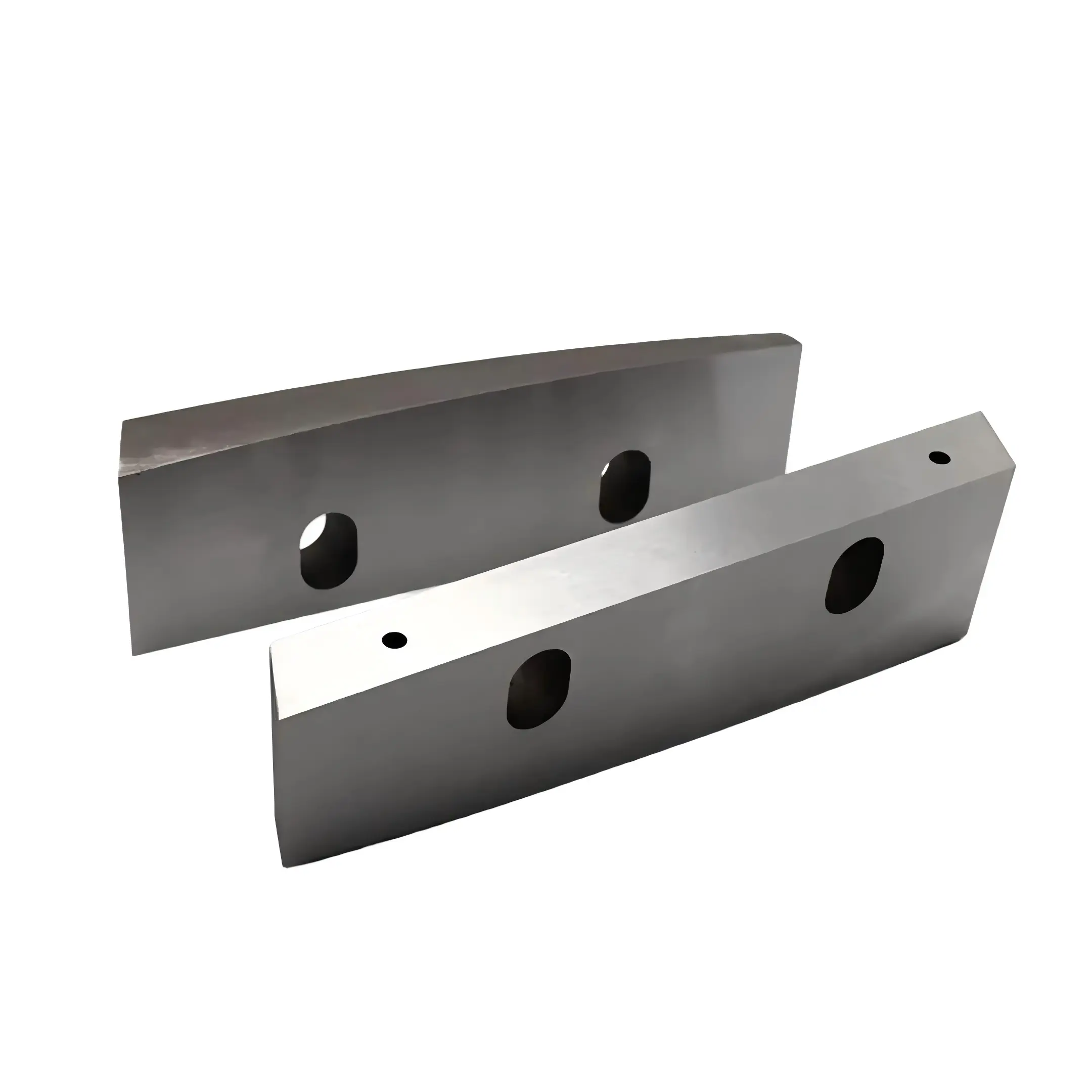
Heavy-Duty Scrap Chopper Blades for Metal Slitting & Coil Processing Lines
Scrap Chopper Blades
Specifically engineered to survive the chaotic, extreme-impact environments of processing line edge-trim chopping. Forged from S7 shock-resisting tool steel or featuring specialized carbide-inlaid geometries, these blades cleanly fracture and reduce irregular steel strips, aluminum strip trim, and copper foil edge scrap without suffering catastrophic blade failure or chipping.
- ■Material: S7 Shock-Resisting Tool Steel | H13 Hot-Work Steel | Carbide-Inlaid S7
- ■Application: Steel, aluminum, copper edge-trim scrap from slitting & coil processing lines
■ ISO 9001:2015 Certified
■ In-House Heat Treatment
■ Strict Dimensional Tolerances
■ Global Door-to-Door Delivery
[ Engineering Reference ]
Decisive Specifications
| Material | S7 Shock-Resisting Tool Steel | H13 Hot-Work Steel | Carbide-Inlaid S7 |
|---|---|
| Hardness | HRC 54–58 (optimized for maximum impact toughness) |
| Edge Configuration | Square/Rectangular Profile (4-edge usable) |
| Impact Resistance | 2× toughness vs. D2 — prevents catastrophic fracture |
| Application | Steel, aluminum, copper edge-trim scrap from slitting & coil processing lines |
| Cycle Life | 50,000–200,000 chops (material & contamination dependent) |
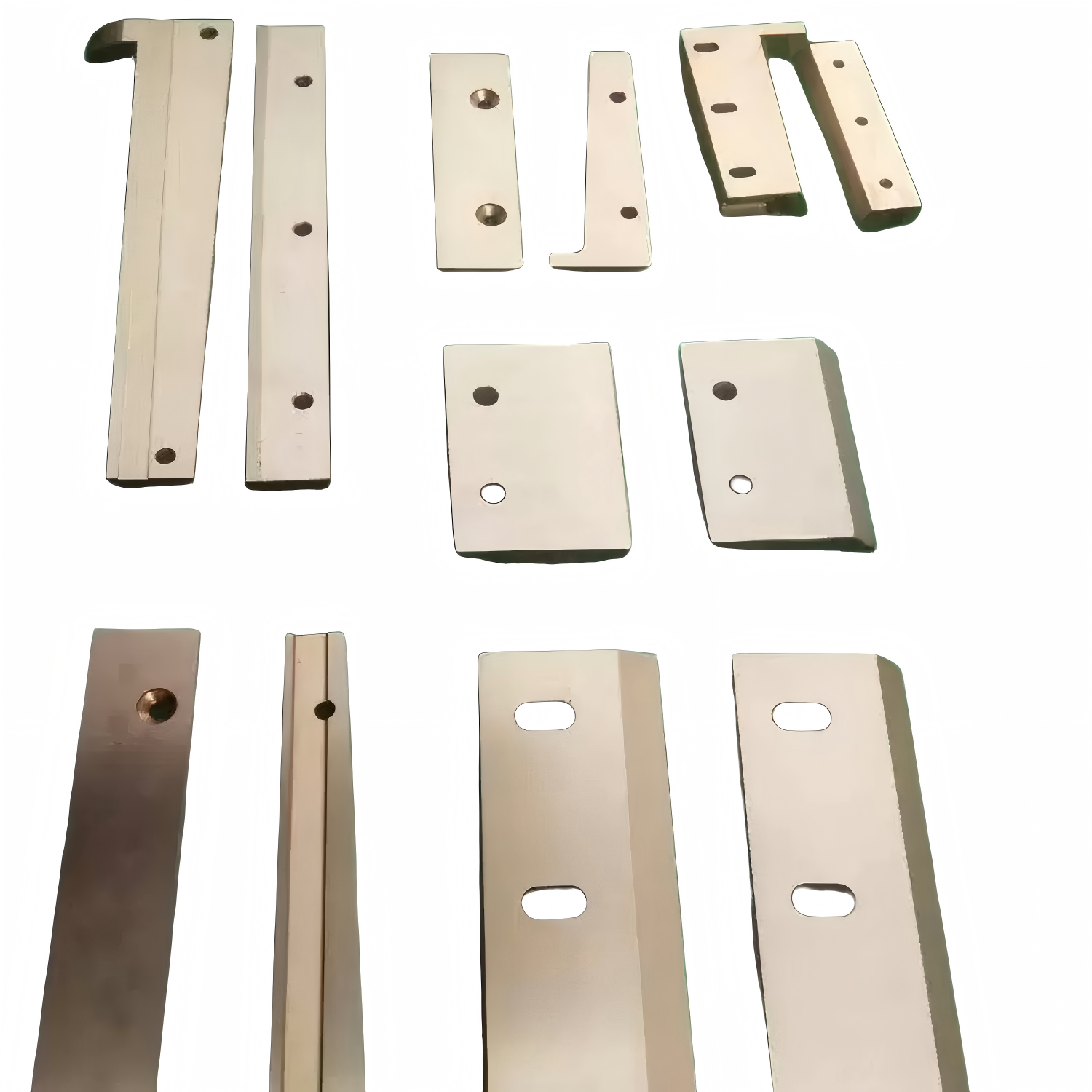
■ All values verified via CMM inspection · ISO 9001:2015
[ RFQ Prompt ]
Need a Specific Size or OEM Replacement?
Don't see your exact specs? Send us a blueprint, a worn sample, or just your machine model. Our team will review the details and provide a tailored quotation.
[ Standard Reference ]
Common Standard Dimensions
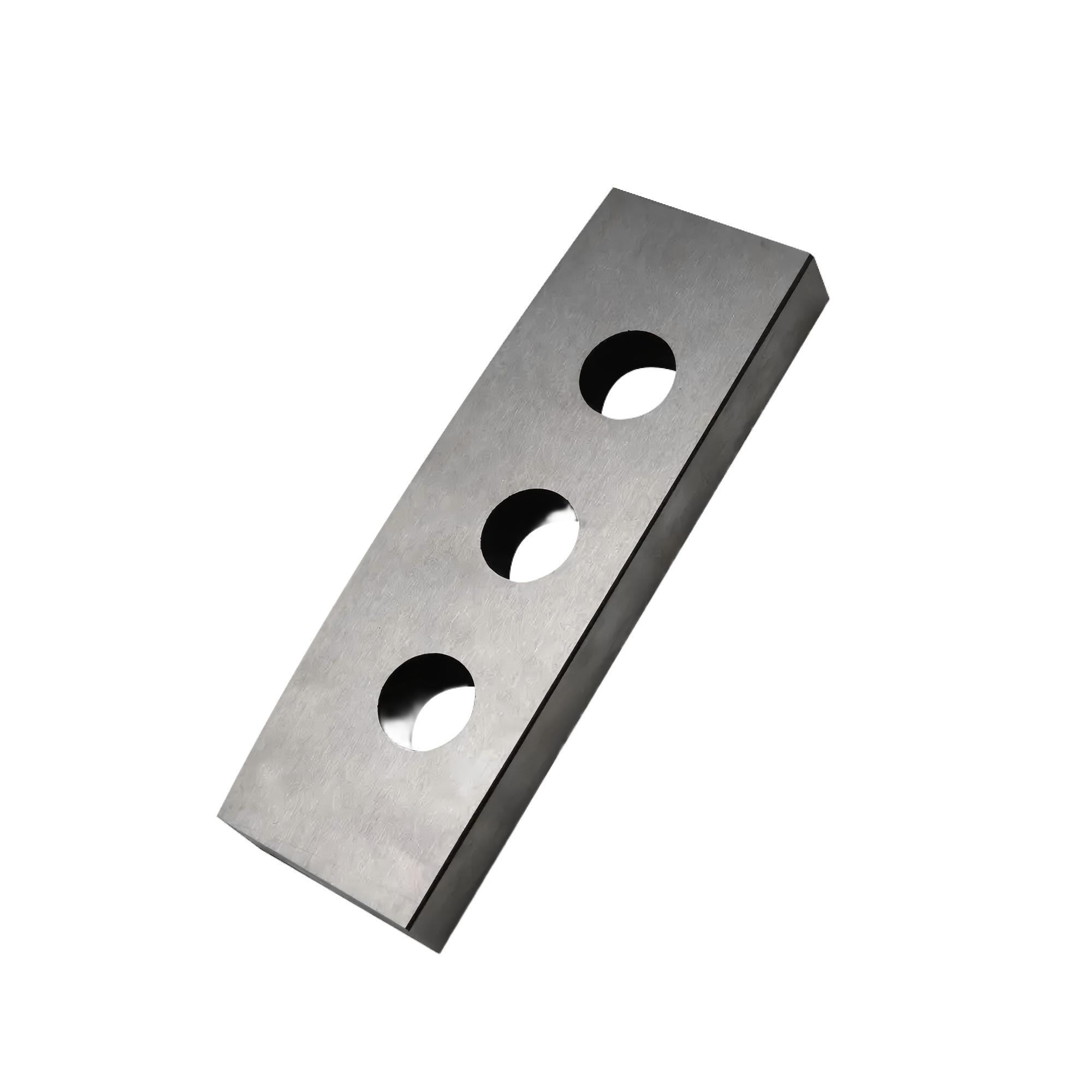
| Typical Machine / Duty | Length (mm) | Width (mm) | Thickness (mm) |
|---|---|---|---|
| Light Gauge Trim | 100 | 40 | 15 |
| Standard Capacity | 150 | 50 | 20 |
| Butech / Medium Duty | 200 | 60 | 25 |
| Heavy Duty Coil Line | 250 | 80 | 25 |
| Extra Heavy | 300 | 80 | 30 |
| Extreme Plate Chopper | 400 | 100 | 30 |
[ OEM Compatibility ]
Compatible Machine Brands
® Registered trademarks are property of their respective owners. Sureay supplies compatible replacement blades — not OEM-branded parts.
[ Technical Audit ]
Engineering Advantages
S7 Shock-Resisting Alloy Structure
S7 tool steel achieves its superior toughness through a carefully balanced alloy system: 0.50% carbon (vs. 1.55% in D2) minimizes brittle carbide formation, while chromium (3.25%), molybdenum (1.40%), and tungsten (1.80%) additions provide hardenability and temper resistance. Heat treated to HRC 54–58 rather than the HRC 60–62 typical of D2, S7 sacrifices some abrasion resistance in exchange for double the Charpy impact energy. This is the critical trade-off for scrap chopper applications: the blade must absorb unpredictable shock loads without shattering.
Four-Edge Reversible Configuration
Scrap chopper blades are manufactured as rectangular blocks with four usable cutting edges. When the active edge exhibits visible wear (typically indicated by increased chopping noise or incomplete scrap fracture), the operator indexes the blade 90° to present a fresh edge. This design quadruples the effective service life compared to single-edge blades and reduces non-productive downtime. The blade body geometry is precision-ground to ensure all four edges are parallel within ±0.05mm, preventing uneven loading that would cause premature wear on indexed edges.
Carbide-Inlaid Hybrid Construction
For steel service centers processing high-carbon or stainless steel trim with heavy mill scale contamination, we offer carbide-inlaid scrap chopper blades. A tungsten carbide insert (typically 6–10mm wide, full blade thickness) is mechanically locked into a precision-ground slot in the S7 body using a shrink-fit or brazed joint. The carbide provides localized wear resistance where the blade contacts the scrap, while the S7 body absorbs the gross impact energy. This construction is the optimal solution for contaminated scrap streams where solid carbide would fracture and solid S7 wears too rapidly.
[ System Inventory ]
Related Blade Categories
View All →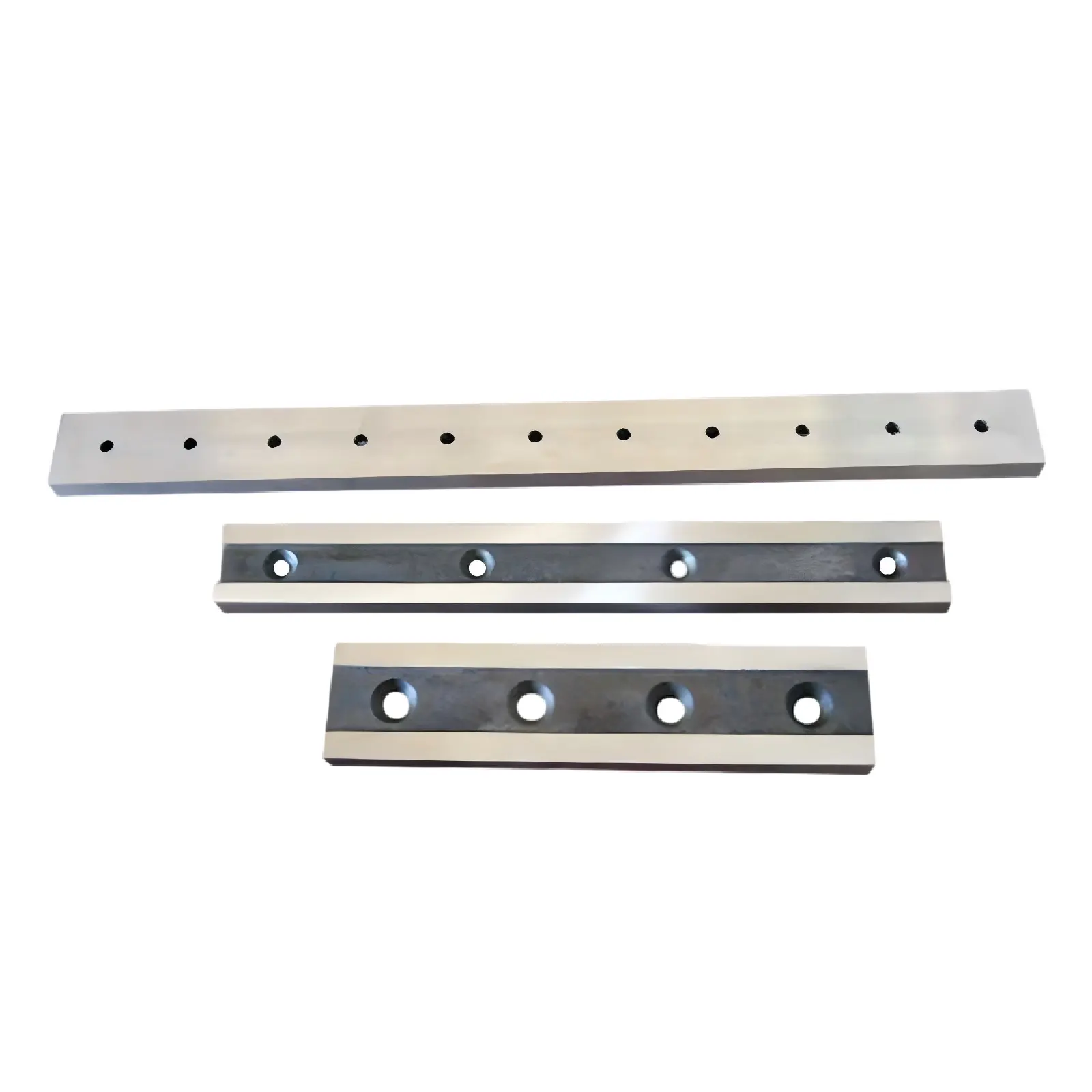
[ Knowledge Base ]
Product FAQs & Buying Guidance
Technical FAQs
01Should I use S7 or H13 for chopping stainless steel edge trim?
+−
Should I use S7 or H13 for chopping stainless steel edge trim?
For stainless steel trim (304, 316, or duplex grades), specify S7 at HRC 54–58. Stainless generates higher cutting forces than mild steel due to work hardening, and S7's balanced alloy system provides better edge retention than H13 in this application. H13 is optimized for aluminum and copper scrap where the lower cutting forces allow the softer H13 matrix to absorb impact without excessive edge deformation. For heavily contaminated stainless scrap with weld spatter or fasteners, upgrade to carbide-inlaid S7.
02How do I know when to index the blade to the next cutting edge?
+−
How do I know when to index the blade to the next cutting edge?
The primary indicator is increased chopping noise or vibration, which signals that the active edge has developed a wear flat and is no longer cleanly fracturing the scrap. Visually, inspect the active edge every 8–12 hours of operation. When the wear flat (the dulled, polished zone on the cutting corner) exceeds 1.0–1.5mm width, it is time to index to the next edge. Indexing before the wear flat contacts the blade body prevents accelerated wear on the holder and frame.
03Can scrap chopper blades be resharpened or reground?
+−
Can scrap chopper blades be resharpened or reground?
Scrap chopper blades are a wear consumable and are not typically reground. The 4-edge reversible design already provides extended service life, and regrinding would require re-heat-treatment and precision grinding to restore the edge geometry and hardness. The cost of regrinding approaches 60–70% of new blade cost, making replacement more economical. However, for very large custom blades (above 500mm length), regrinding may be cost-effective — contact us with your blade dimensions.
Why Choose Sureay
01Does Sureay stock scrap chopper blades, or are they made to order?
+−
Does Sureay stock scrap chopper blades, or are they made to order?
We maintain stock inventory of standard S7 scrap chopper blades in the six most common sizes (100×40×15mm through 400×100×30mm). Stock blades ship within 3–5 working days. Custom dimensions, H13 material, and carbide-inlaid configurations are manufactured to order with lead times of 12–18 working days from drawing approval. Rush production (7–10 days) available for standard sizes subject to heat-treat schedule availability.
02Can Sureay supply scrap chopper blades that match our existing blade dimensions?
+−
Can Sureay supply scrap chopper blades that match our existing blade dimensions?
Yes. Send us a sample blade, technical drawing, or the chopper machine make and model number. We will confirm the length, width, thickness, mounting hole pattern (if applicable), and material grade. Most chopper blades are standard rectangular blocks without mounting holes, but some models use clamped or bolted retention that requires specific hole locations. We can replicate any existing blade geometry.
Reach Our Team
Get in Touch with Our Engineers
Contact Our Team
Discuss your requirements directly with our engineers.
Request a Quote
Our engineering team responds within 2 hours.