[ PRODUCT CATALOGUE — INDUSTRIAL BLADES ]
Premium alloy steel blades for recycling, paper, and converting industries — engineered for maximum wear resistance and extended service life.
Best SellerOEM AvailableRotary Slitter Knives
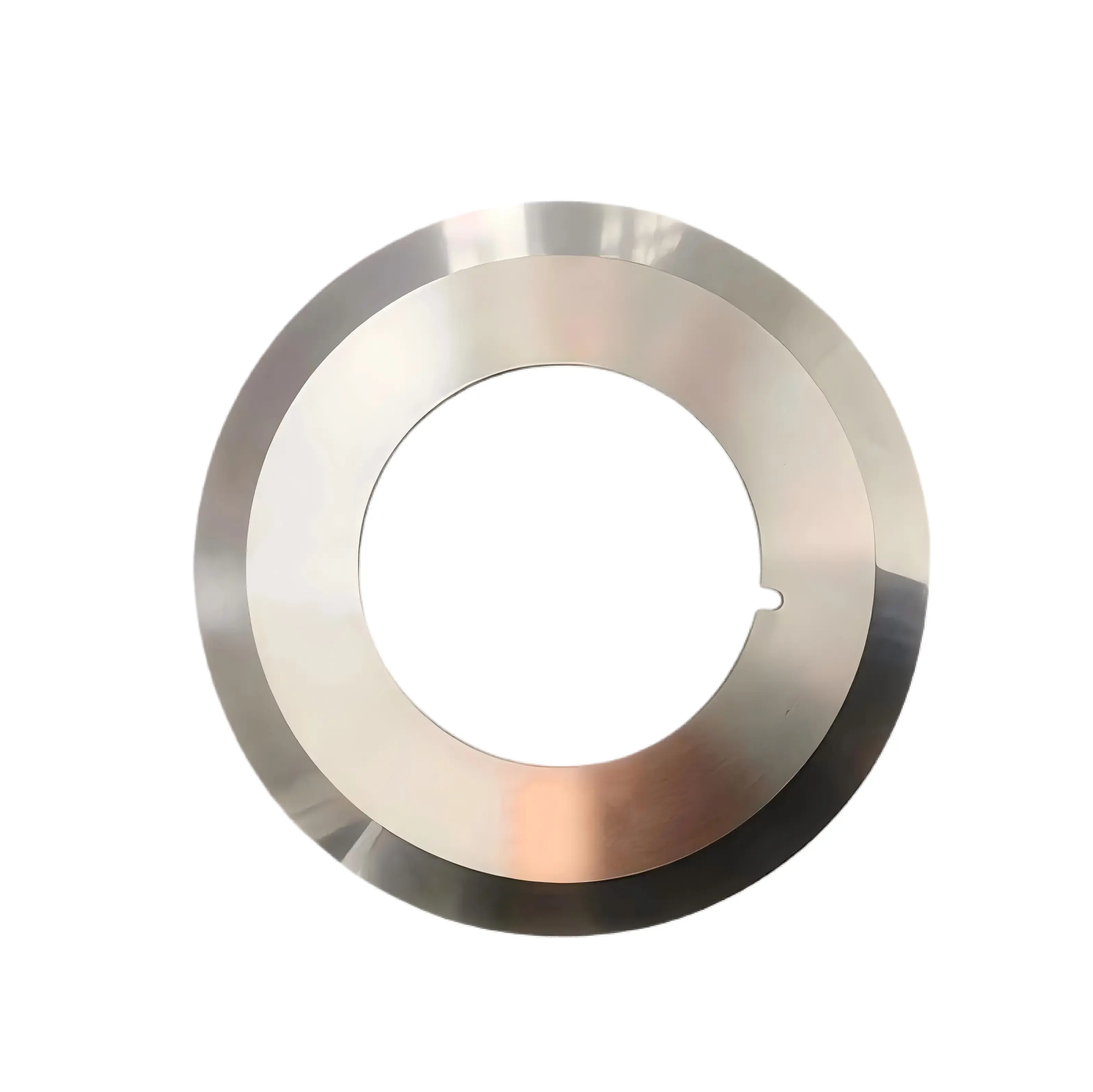
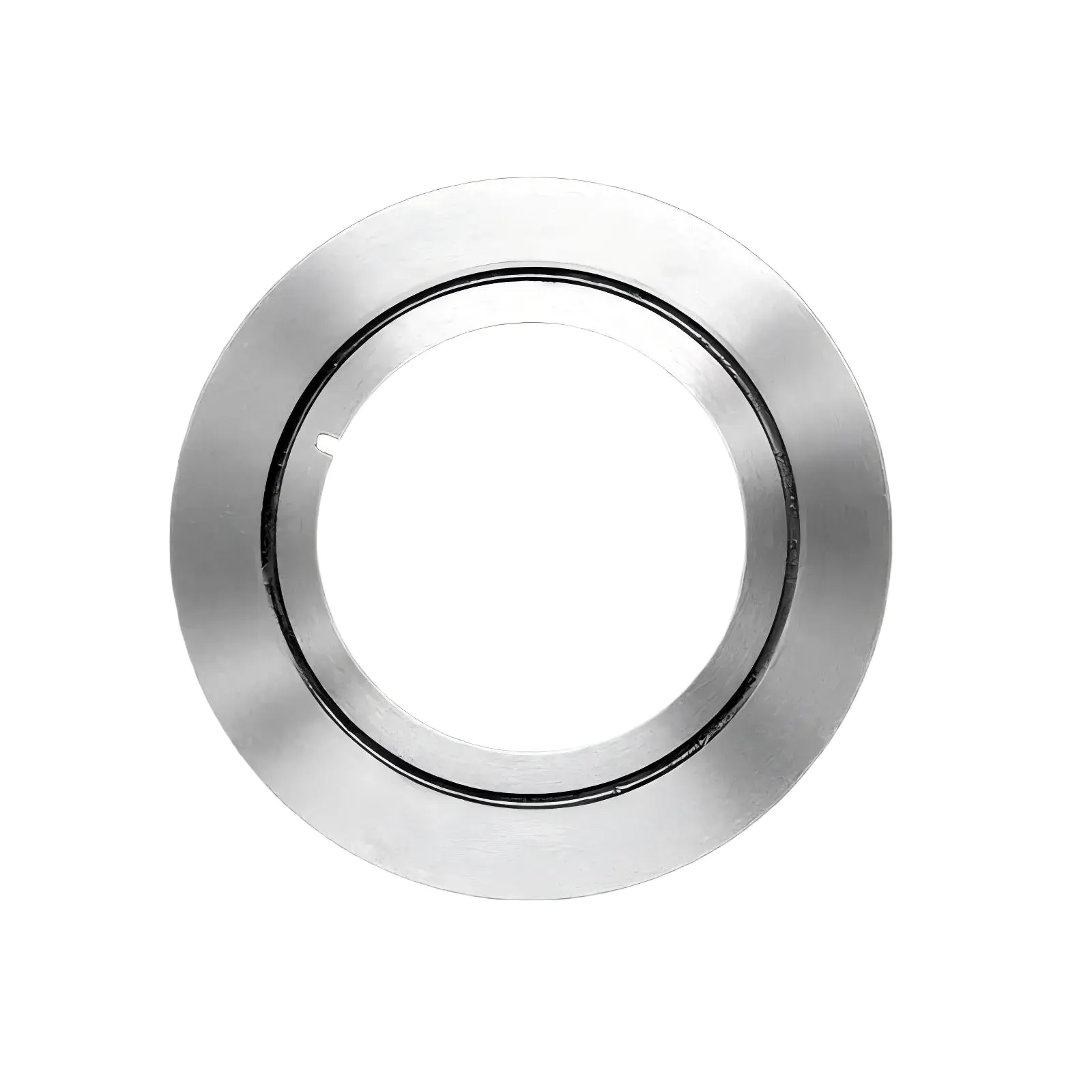
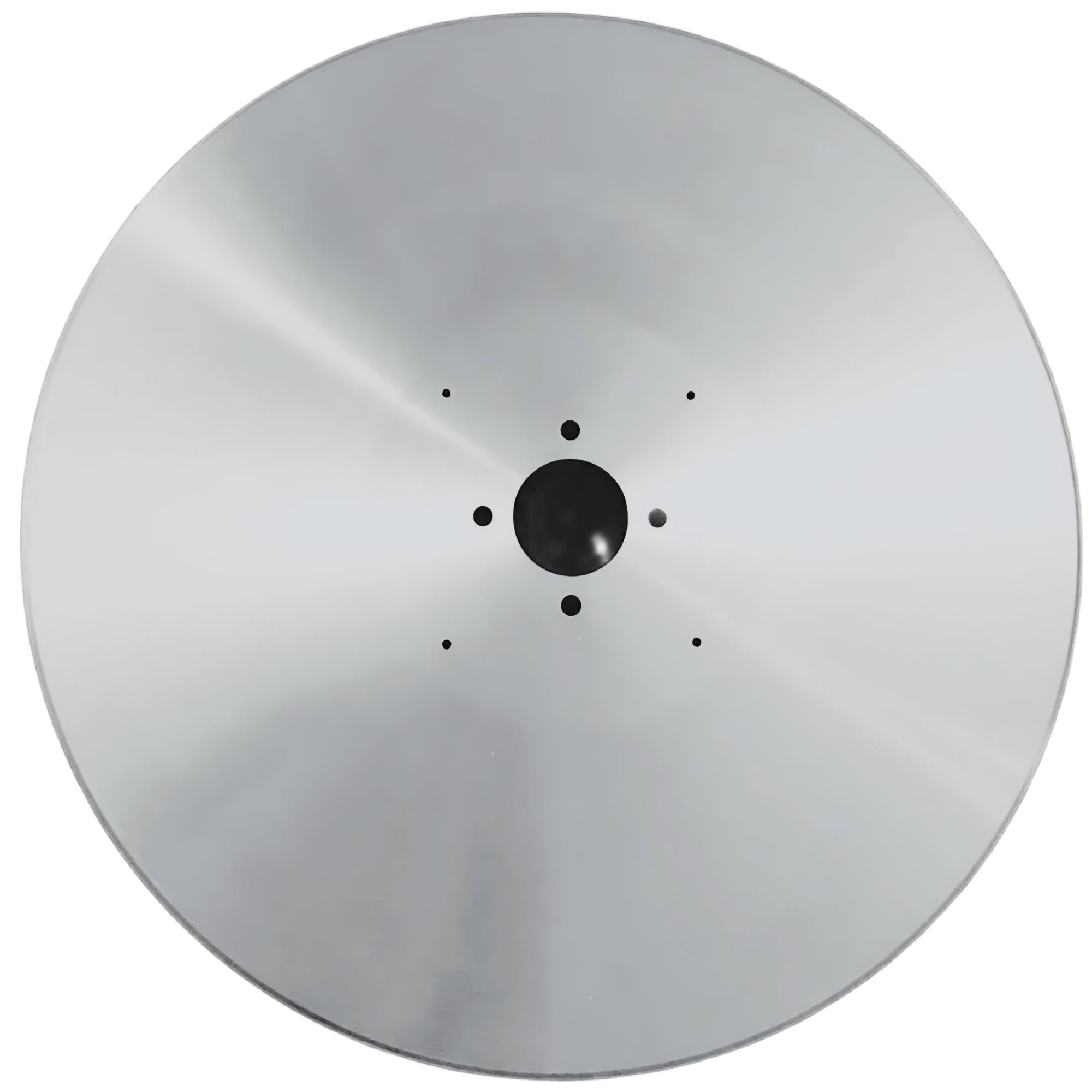
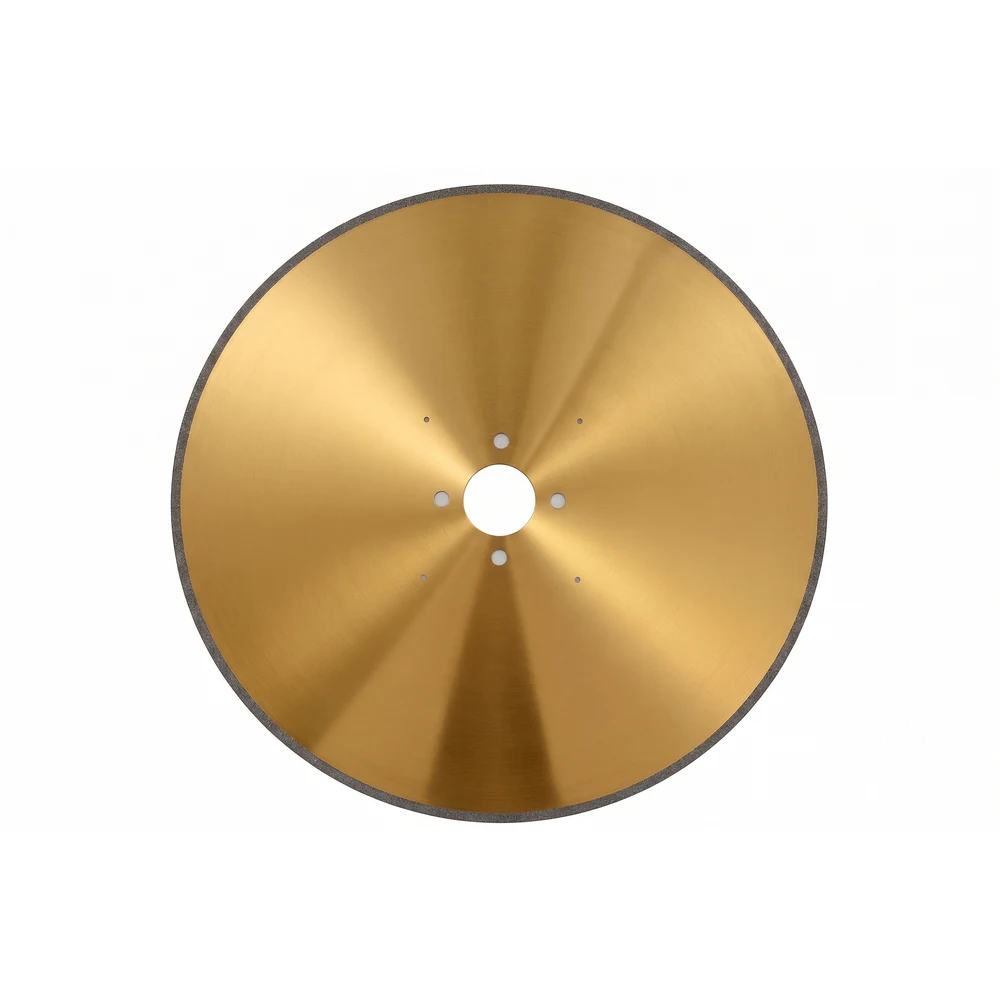
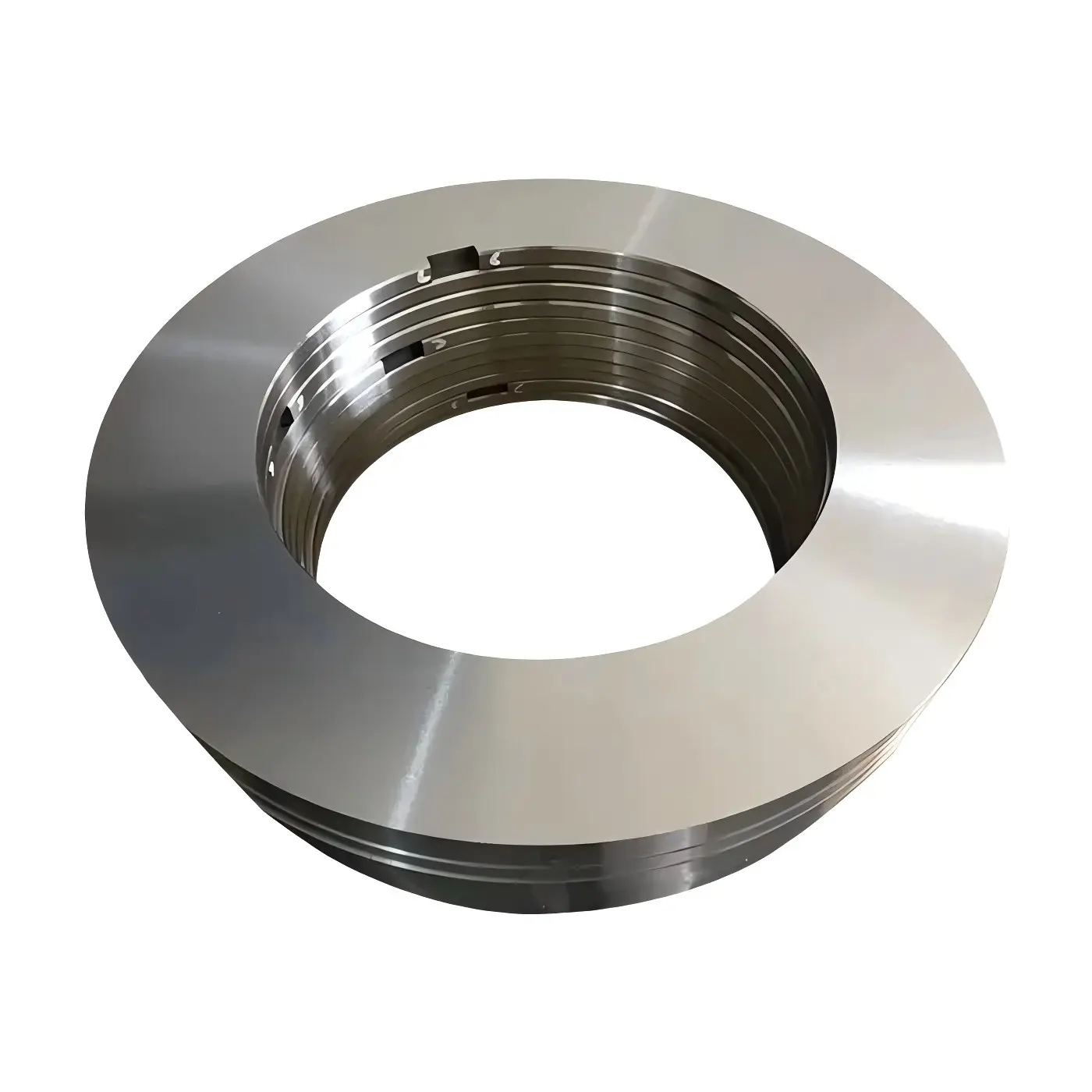
Circular rotary slitter knives operate at the intersection of dimensional precision and material science. On a converting line running BOPP or BOPET film at 400–600 m/min, a blade thickness tolerance error of 0.005mm per knife compounds across a multi-knife arbor stack, producing visible slit-width deviation, edge curl, and dust that contaminates downstream rewinding and packaging equipment. Sureay rotary slitter knives are manufactured to ±0.002mm thickness tolerance and ≤0.02mm total indicated runout (T.I.R.)—tolerances that hold across the full production diameter, not just at the bore. Alloy selection is application-determined. Standard converting of coated paper and kraft board runs on 52100 bearing steel or D2 cold-work tool steel. Abrasive substrates—battery-grade aluminum and copper electrode foils for EV lithium cells, fiberglass-reinforced packaging, silicon-coated release liners—require ASP23 or ASP52 powder-metallurgy (PM) steel or solid carbide for acceptable edge life. Flexible plastic films (BOPP, BOPET, CPP, PE stretch film) are routinely processed on M2 HSS blades with optional TiN or DLC PVD surface coating to prevent adhesive film transfer and reduce friction-induced web heating. ## By Cutting Method **Shear Slitting (Matched Top & Bottom Knife Pairs):** The scissor action between the dished upper knife and grooved lower anvil knife generates a clean shear cut with zero tensile loading on the web. Knife-to-knife clearance is typically set at 0.05–0.15mm (substrate-dependent); our grinding tolerances ensure this clearance is consistent across the full slit width. Critical for paper, non-wovens, and light flexible films where edge deformation is unacceptable. **Crush/Score Cutting (Circular Blade Against Rubber Anvil Roll):** A hardened, sharp-edged blade penetrates through a pressure-sensitive adhesive laminate, foam, or multi-layer packaging web against a controlled-hardness rubber anvil. Blade profile geometry and bevel angle are optimized per substrate to prevent adhesive squeeze-out and delamination at the cut edge. The standard choice for pressure-sensitive tape, foam die-cutting, and medical packaging splitting. **Razor Slitting (Free-Float or Fixed Single Blade):** Ultra-sharp, thin-profile blades trim edge waste from cast film extrusion lines, oriented film lines, and nonwoven spunbond production at speeds above 500 m/min. Blade geometry is optimized for minimum web drag and maximum edge cleanliness, preventing edge curl and electrostatic discharge that cause web break events on high-speed lines. ## By Material & Industry **Paper & Board:** Tissue, kraft, newsprint, coated art paper, folding boxboard. Dust-free edge quality is mandatory for downstream printing and lamination; D2 or M2 HSS blades with Ra ≤ 0.4 surface finish meet all major converting house specifications. **Flexible Packaging Films:** BOPP, BOPET, CPP, PE/PP stretch film, shrink sleeve. High-speed film slitting requires precise runout control to prevent knife wobble-induced web tension spikes. M2 HSS with optional DLC coating eliminates film transfer adhesion on the blade face. **Battery Electrode Foils:** Aluminum cathode and copper anode foil for lithium-ion cell manufacturing. Dimensional variances above ±0.003mm contaminate ISO Class 7 cell assembly environments. PM-steel or solid carbide grades are mandatory; contamination-free handling and cleanroom-compatible packaging available. **Non-Wovens & Medical Fabrics:** Spunbond PP, meltblown, SMS medical fabrics, HEPA filter media. Specialized rake angles prevent fiber fraying and web slippage during slitting of loose-structure materials at high line tensions. **Pressure-Sensitive Tapes & Labels:** Masking, duct tape, double-sided foam, label stock, transfer adhesive. TiN and Teflon anti-adhesion coatings reduce cleaning frequency by 60–80%, extending Mean Time Between Replacements on the most demanding tape-slitting applications.
OEM AvailableShredder Blades
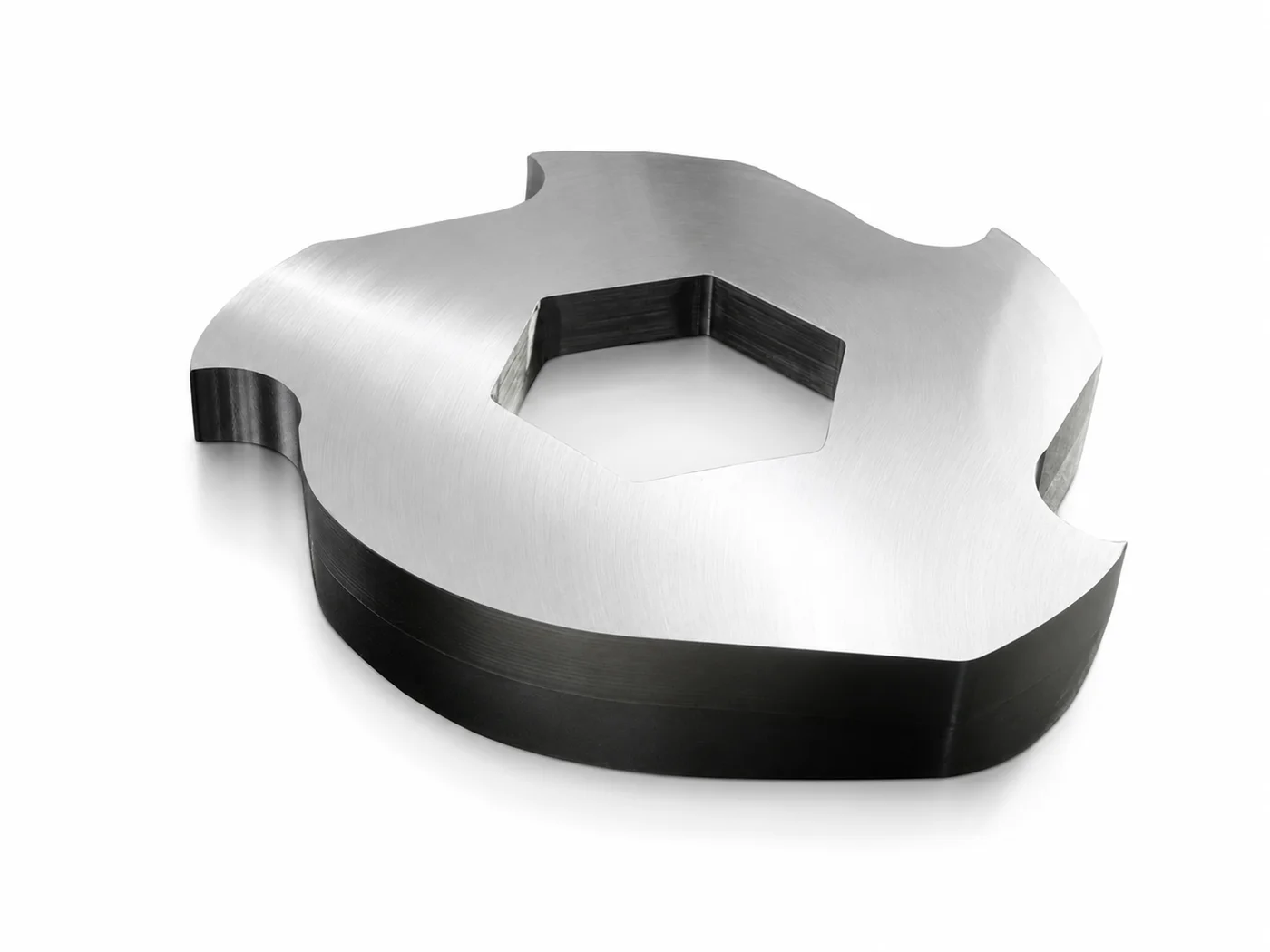
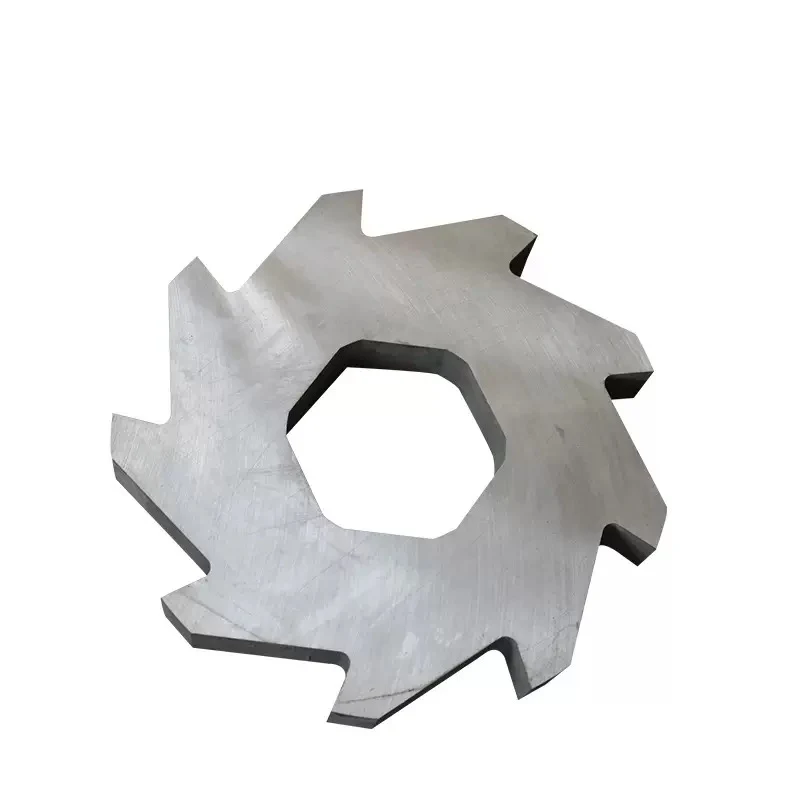
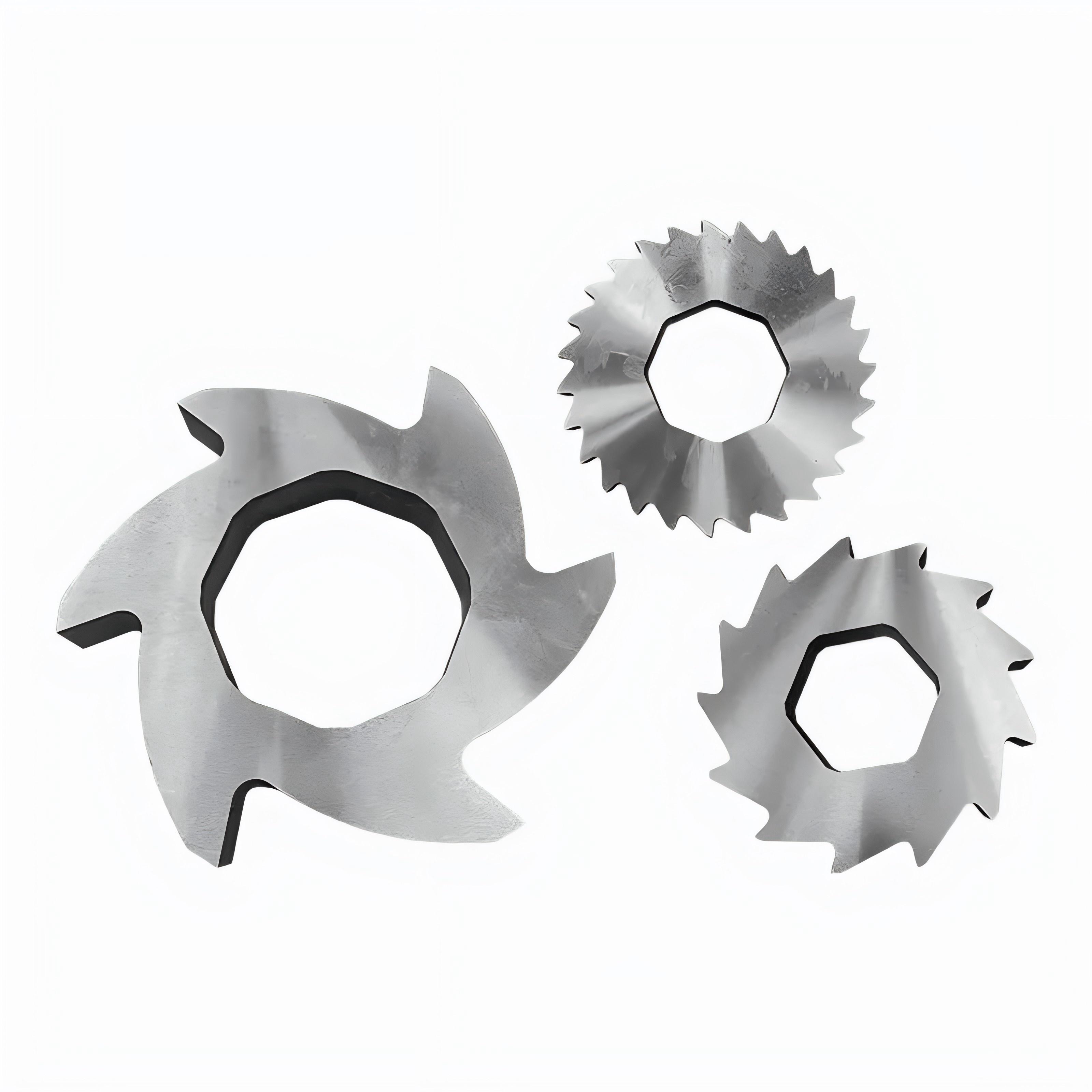
Two-shaft, four-shaft, and fine-shredding rotors impose a fundamentally different stress profile on cutting inserts compared to single-shaft systems. The counter-rotating disc geometry generates continuous shear loads at moderate torque, requiring inserts that resist progressive abrasive wear rather than single-cycle impact. Premature insert failure on multi-shaft rotors—characterized by edge rounding, face pitting, and counter-bore elongation—is almost exclusively caused by incorrect alloy selection or insufficient heat treatment depth. Sureay multi-shaft shredder inserts are manufactured from D2 (1.2379) and DC53 cold-work tool steels, vacuum-hardened and deep-cryogenically processed to HRC 52–58. The cryogenic sub-zero stage (−80°C, 24-hour soak) eliminates retained austenite, stabilizes the martensite microstructure, and increases wear resistance without sacrificing the toughness margin needed to prevent bulk fracture on contaminated plastic feedstocks. Every M12, M16, and M20 counter-bore is CNC-milled to ±0.05mm positional tolerance. This precision eliminates the micro-rocking under load that gradually elongates counter-bores in lower-tolerance inserts—a progressive failure mode that forces premature rotor rebuilds. ## Self-Centering Concave Face Geometry The precision-milled concave cutting face generates a superior scissor-shear action between opposing rotor disc inserts. Compared to a flat-face geometry, the concave profile reduces the shear contact area at each cutting event, lowering the instantaneous shear force and dramatically reducing heat generation at the cutting zone. This directly prevents thermoplastic material melting and adhesion on the blade face—a critical reliability factor when processing polypropylene, LDPE film bales, and mixed plastic waste with high surface-area-to-mass ratios. ## Four-Way Indexable Design: Total Cost Reduction The symmetrical square insert geometry provides four independent cutting edges per blade, each presenting a fresh, factory-ground working face when rotated 90° under the mounting bolt. A single operator rotates a full rotor complement in under 15 minutes without machine disassembly. This indexable design quadruples the effective service interval per blade purchase versus non-indexable alternatives, directly reducing the annual per-tonne tooling cost of your shredding operation. ## Alloy Specifications by Feedstock **D2 (1.2379) — Standard Contaminated Plastics:** Optimized for post-consumer HDPE bottles, PET trays, PP injection-moulded parts, and mixed rigid plastic bales. The high chromium-carbide content delivers reliable abrasion resistance at an economical cost point. **DC53 — Hard Engineering Plastics:** Specified for high-density nylon (PA6, PA66), ABS, polycarbonate, PEEK, and glass-fibre-reinforced compounds that exceed the abrasion resistance ceiling of standard D2. DC53's finer carbide distribution and higher transverse rupture strength provide extended edge retention on hard-face materials. **42CrMo — Rubber & Metal-Inclusive Waste:** For rubber-inclusive streams (tyres, conveyor belts, EPDM extrusions) or industrial scrap with metal contamination risk. The higher toughness of 42CrMo prevents the brittle fracture that causes catastrophic rotor damage when a hidden metal inclusion contacts the cutting disc. ## OEM-Compatible Dimensions Insert geometry, counter-bore pattern, and disc OD are reverse-engineered from factory-measured OEM samples to guarantee drop-in fit on Vecoplan VA/VNZ series, Weima WLK series, Untha RS/XR series, and Lindner Urraco and Polaris platforms. Custom counter-bore patterns and alloy specifications are available within a 15-day production lead time.
OEM AvailableTissue Paper Blades
The tissue log cross-cut is the single highest-stakes cutting operation in a tissue converting line. A dimensional defect at this stage—torn edge fibers, dust migration, or non-perpendicular cut face—propagates immediately through the wrapping and packaging stations, triggering line stops and consumer-grade quality rejections that cannot be reworked downstream. Sureay tissue log saw blades are manufactured from D2 cold-work tool steel and M2 HSS (SKH-9), vacuum-hardened in-house and micro-ground to the following verified geometric tolerances: - **Lateral runout:** ≤ 0.15 mm - **Edge runout:** ≤ 0.10 mm - **Face parallelism:** 0.05 mm - **Concentricity (OD to bore):** ≤ 0.30 mm - **Blade body verticalness:** ≤ 0.05 mm - **Bore tolerance:** Ø 68.26 mm (+0.05 / 0.00 mm) These are not nominal values—they represent the maximum permissible deviation on each shipped blade, verified on a calibrated CMM before dispatch. ## Blade Geometry Engineered for Tissue Fiber Tissue substrate is structurally unique among industrial cutting applications: it is a low-density, high-surface-area fibrous web with near-zero compressive strength but high tear resistance along the fiber orientation. The correct log saw blade geometry exploits this anisotropy. The shallow bevel angle (15°–25°) delivers a wedge action that separates fibers by shear rather than compression, preventing the fiber crushing and edge densification that generates dust and reduces roll softness ratings. The mirror-polished blade face (Ra ≤ 0.4 μm) eliminates fiber adhesion sites, allowing continuous high-cycle operation without periodic blade face cleaning stops. Blade body thickness (3.80–6.00 mm) is selected based on log diameter and feed rate. Thicker blades resist lateral deflection at high feed rates, maintaining perpendicular cut faces essential for uniform roll height in consumer-packaged goods. ## Surface Treatments for Production Environment **Hard Chrome Plating:** Provides corrosion resistance in high-humidity paper mill environments (>75% RH). Also reduces tissue fiber adhesion coefficient, extending the clean-running interval between blade dressing cycles. **TiN PVD Coating:** Physical vapour deposition titanium nitride coating (2–3 μm) provides both corrosion resistance and a surface hardness of HV2300+, significantly extending the sharp-edge service interval in high-cycle operation. Recommended for premium tissue brands with strict dust specification requirements. ## Machine Compatibility **Standard bore Ø 68.26 mm (+0.05mm):** Fabio Perini (all series), PCMC Forte/Elite, Körber/MTC log saws. **Ø 82.55 mm bore:** Casmatic (Kimberly-Clark licensed), Italian and Spanish third-party OEM log saw platforms. **Ø 60.00 mm bore:** Large-format log saws for industrial wiper, jumbo roll, and coreless bath tissue production (OD 870–1000 mm). Custom OD from Ø 610 mm to Ø 1200 mm are manufactured to order with a standard 10-working-day production lead time. Drawing review and dimensional sign-off available prior to production on first-order tooling.
OEM AvailableGranulator Blades
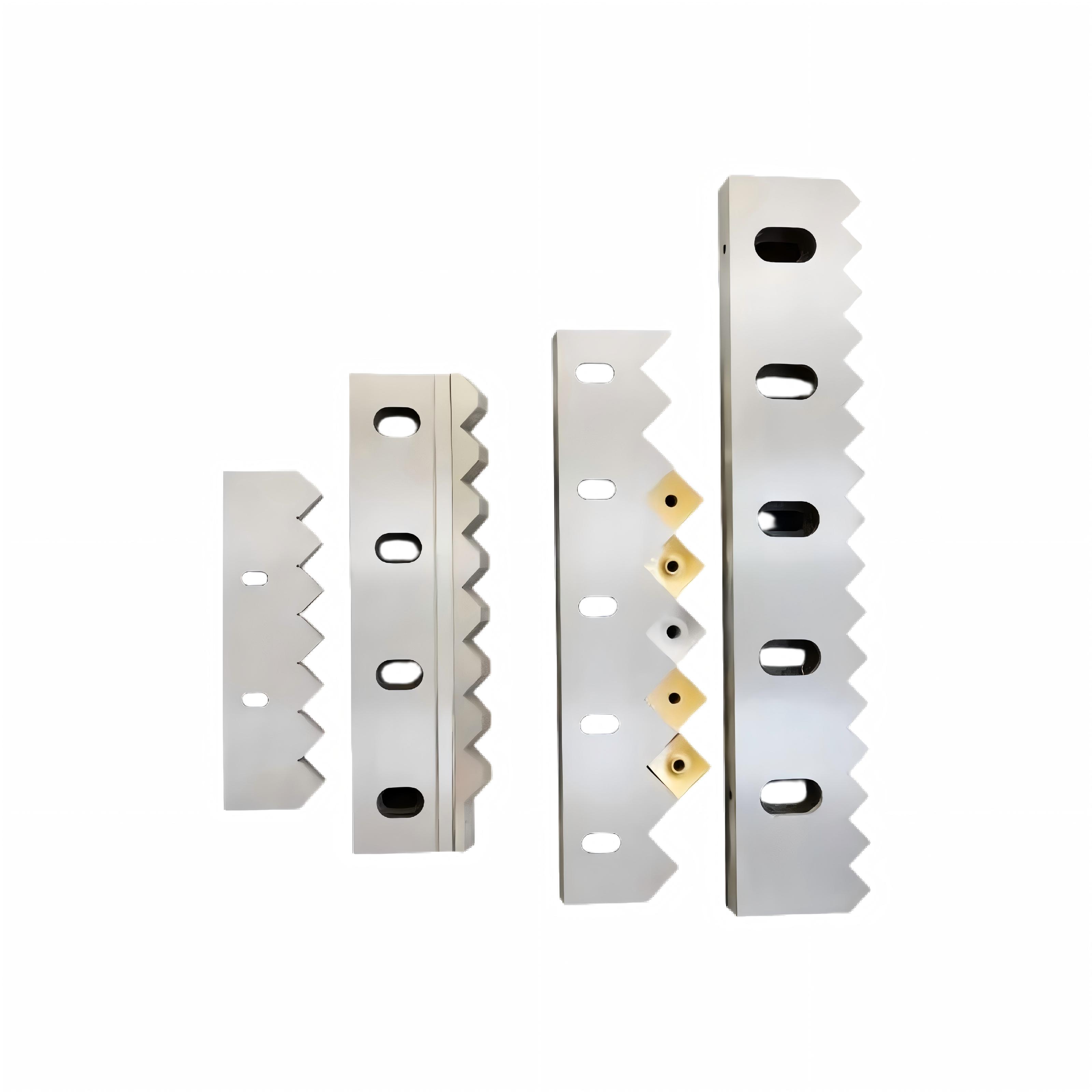
Granulator rotor and stator knives are the highest-wear components in any closed-loop plastic recycling line. Incorrect alloy selection or substandard geometry tolerances directly translate into enlarged particle size distribution, excessive dust and fines, elevated motor amp draw, and shortened sharpening intervals—all of which degrade regrind pellet quality and increase cost per tonne processed. Sureay granulator blades are manufactured from D2 (1.2379), SKD-11, DC53, and Cr12MoV cold-work tool steels—selected based on the specific polymer and abrasive filler content being processed. Calcium carbonate-filled PVC and glass-fibre-reinforced nylon demand SKD-11 or DC53 for maximum abrasion resistance. Impact-loaded applications such as thick-wall HDPE containers, cold nylon runners, and heavy sprues require the higher toughness-to-hardness ratio of Cr12MoV. All blades are vacuum-hardened and deep-cryogenically processed at −80°C to achieve a stabilized HRC 58–62 microstructure. The cryogenic step eliminates retained austenite, reduces internal compressive stress, and significantly extends the time between sharpening cycles by improving carbide dispersion uniformity across the cutting edge. ## Precision Grinding Standards The cutting clearance between rotor and stator knives is the single most influential variable controlling regrind particle size and fines fraction. Sureay granulator blades are machined to the following tolerances to ensure consistent rotor-to-bed gap across the full cutting width: - **Bolt-hole positional tolerance:** ±0.02 mm - **Face flatness:** 0.05 mm - **Parallelism (top face to bottom face):** 0.03 mm - **Bevel angle:** 30°–55° (application-optimized per polymer and rotor speed) A face flatness deviation above 0.08mm allows rotor knife rocking under load, progressively widening the cutting gap and increasing the coarse fraction in regrind—a defect that causes downstream extruder feed inconsistency and pellet quality non-conformances. ## Polymer-Specific Bevel Angle Selection **30°–35° bevel:** Soft thermoplastics (LDPE, LLDPE, EVA, foam PP). Low included angle delivers maximum sharpness for clean shearing of compliant materials that would deform rather than shear against a wide-angle edge. **40°–45° bevel:** General-purpose engineering plastics (HDPE, ABS, standard PP/PET regrind). Balanced edge strength and sharpness for the most common granulator feedstocks. **50°–55° bevel:** Highly abrasive or filled compounds (glass-filled nylon, calcium carbonate PVC, UHMW-PE). Wider bevel distributes abrasive wear over a larger cutting face, extending sharpening interval at the cost of slightly higher cutting force. ## Machine Compatibility Dimensions are reverse-engineered to match Cumberland (all series), Conair/Wortex, Amacoil, Alpine, Ganutec, Foremost, Nelmor, Mitts & Merrill, Herbold, Pallmann, Dreher, Rapid, Hydreclaim, Buss-Condux, IMS, and Ramco (R&M) granulator configurations. Both double-hole and multi-hole (triple, quadra) mounting patterns are carried in standard stock. Custom profiles for beside-the-press in-line granulators on injection moulding and extrusion blow moulding lines are produced to customer drawing within 10 working days.
PrecisionOEM AvailablePaper Cutting Blades
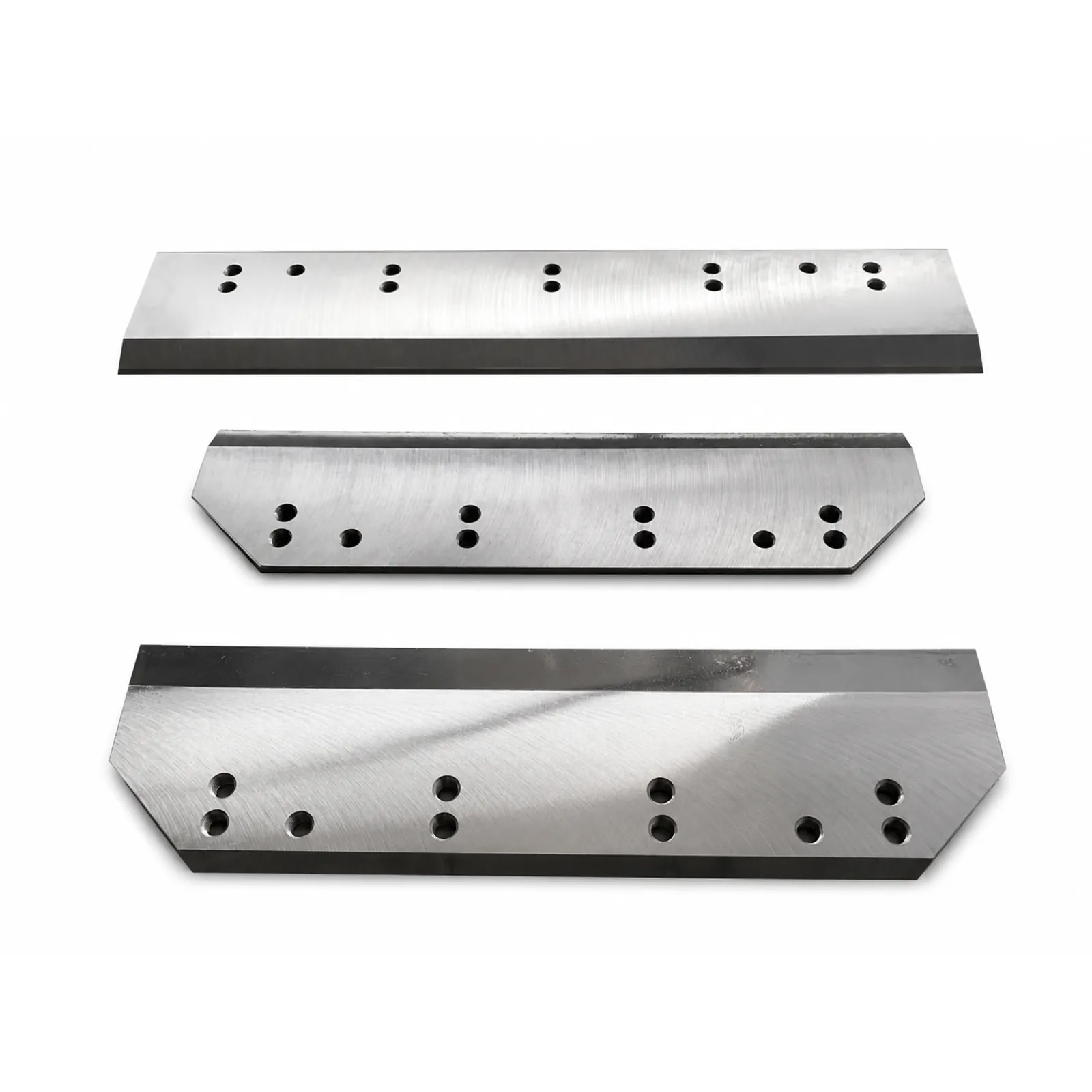
Guillotine paper cutter replacement blades are consumed components whose alloy grade, edge geometry, and full-length dimensional accuracy directly determine cut quality across the entire ream stack—from 450mm office cutter blades to 2050mm double-beam commercial pressroom guillotines. Sureay paper cutting blades are offered in three metallurgical grades, matched to cut volume, substrate, and total cost of ownership requirements: ## Material Grades **Standard Tool Steel (T10, 9CrSi — HRC 57–60):** Cost-effective for moderate-volume print shops and finishing operations cutting bond paper, newsprint, and uncoated stock up to 80 gsm. T10 high-carbon steel is hardened to HRC 57–60 and provides reliable edge sharpness at the lowest unit cost. Suited to Polar, Schneider Senator, and Challenge 305 class machines in moderate daily-cycle environments. **M2 / SKH-9 / SKH-51 HSS (HRC 60–62):** The premium choice for high-volume commercial printing, book publishing, and label-converting guillotines running multiple ream stacks per hour. M2 and SKH-51 HSS retain full hardness at the elevated cutting temperatures generated by high-cycle operation—delivering 4–6× longer service life between resharpening events compared to standard carbon steel blades. Recommended for coated art paper, board, laminated packaging stock, and multi-layer adhesive label sheets where edge wear accelerates rapidly. **TCT Inlay — Tungsten Carbide Tipped (YG15 / YG20):** Nitrogen furnace-brazed carbide edge inlay for the most abrasion-intensive substrates: carbonless copy paper (CBS coating), high-calcium-carbonate-filled packaging board, coated cartonboard, abrasive specialty papers, and fibre-reinforced technical papers. TCT blades outlast HSS on these substrates by a factor of 3–5× and maintain slit-edge quality well beyond the point where HSS would require resharpening. ## Precision Grinding Standards - **Bevel angle:** 21° (standard guillotine geometry, single-bevel) - **Length tolerance:** +2 / −1 mm - **Width tolerance:** ±1 mm - **Edge thickness tolerance:** 0 / −0.1 mm - **Face flatness (full length):** ≤ 0.05 mm Flatness deviation above 0.08mm across the blade length causes uneven blade-to-sideboard contact, producing a tapered cut and requiring operator correction shims—a production inefficiency that accumulates to measurable downtime on high-volume cutting lines. ## Machine Compatibility & Supply States Standard stock lengths from 450 mm to 2050 mm. Compatible with Polar 115/137/155/176/200 series, Schneider Senator, Perfecta, Wohlenberg, Prism, and Challenge guillotine brands. Custom lengths, mounting hole patterns, and back-edge profiles manufactured to drawing within 7 working days. **Available supply conditions:** Sharp-ground edge (ready to install) / Semi-finished edge (for on-site final dressing to machine specification) / Blank knife (unground, for customers with in-house regrinding capability).
Heavy DutyOEM AvailableSingle Shaft Shredder Blades
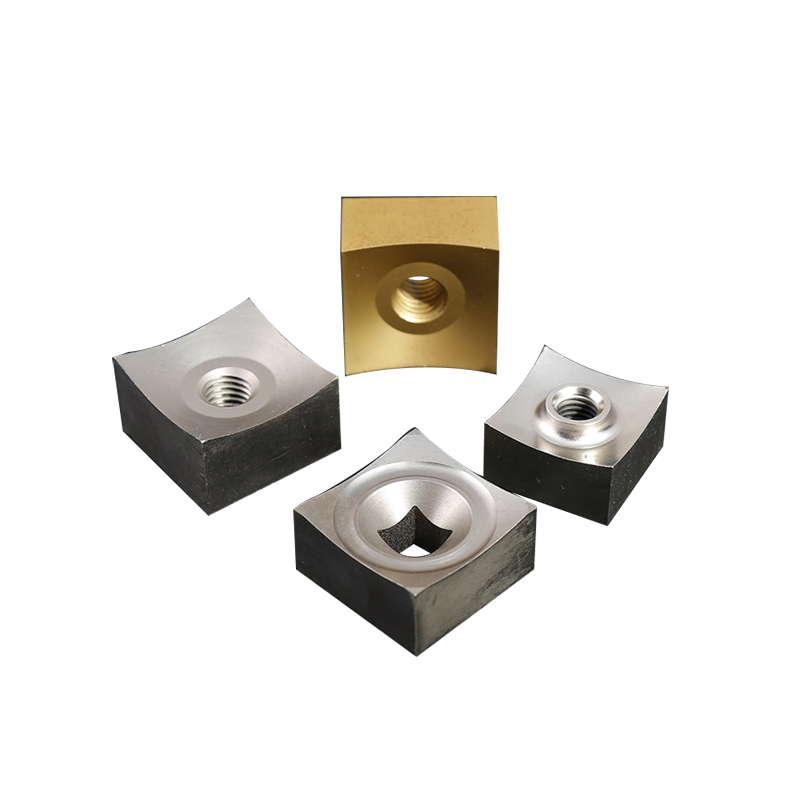
Single-shaft shredders operate at 80–150 RPM under extremely high torque, driving block-style rotor inserts into a stationary bed knife at shear clearances of 0.2–1.5mm. At these mechanical parameters, blade failure mode is not progressive abrasive wear—it is impact-induced edge microchipping from dense material, bulk fracture from hidden foreign metal, or thermal softening from sustained high-cycle torque peaks. Standard D2 (1.2379) tool steel addresses all three failure modes at a cost-effective price point; DC53—with 17% higher transverse rupture strength at equivalent hardness—is specified when hard engineering plastics (PA66-GF, PC, PEEK) or abrasion-intensive rubber compounds demand the additional toughness margin. All rotor inserts undergo vacuum hardening to HRC 58–62 followed by deep cryogenic processing at −80°C. The cryogenic stage eliminates retained austenite, stabilizes the martensite microstructure against thermal fatigue, and dramatically reduces the risk of bulk fracture when rotor inserts encounter unexpected metal inclusions—a common occurrence in post-industrial and MSW feedstreams. ## CNC Machining Tolerances Cutting clearance between rotor insert faces and the stationary bed knife is the principal variable governing shred particle size, throughput, and motor load. Sureay single-shaft inserts are CNC-machined to ±0.02mm face flatness—ensuring consistent, repeatable knife-to-bed clearance across the full rotor stack length and preventing the material wrap-back and rotor stall events caused by uneven clearances on imprecisely machined inserts. ## Four-Edge Indexable Geometry: Cost Reduction in Practice The symmetrical square block format—available from 25×25×20mm (M12 mounting bolt) through 80×80×45mm (M24 mounting bolt)—provides four independent cutting edges per insert. When one edge dulls, the operator loosens the single mounting bolt, rotates the insert 90° to a fresh edge, and retorques. A full rotor complement can be indexed in under 15 minutes without removing the rotor shaft. This single design feature reduces annual tooling expenditure by 75% versus non-indexable alternatives and eliminates the machine downtime associated with rotor extraction for blade replacement. ## Alloy Selection by Feedstock **DC53 — Hard Engineering Polymers:** Nylon (PA6, PA66-GF30), polycarbonate, ABS/PC blends, PEEK, and glass-fibre-reinforced thermoplastics. DC53's finer carbide grain structure and superior toughness prevent the edge microchipping that standard D2 suffers on hard, brittle polymers at low-RPM impact loading. **D2 (1.2379) — General Industrial Plastics:** HDPE, LDPE, PP, PVC pipes and profiles, injection-moulding runners and sprues, PET blow-moulding scrap. The high chromium-carbide content of D2 delivers reliable abrasion resistance across the most common single-shaft shredder feedstocks. **42CrMo — Rubber, Mixed Waste & Metal-Inclusive Streams:** Tyres, conveyor belt offcuts, EPDM seals, and post-industrial scrap with metal contamination risk. 42CrMo's higher impact energy absorption (Charpy V-notch > 25J) prevents brittle fracture that could cause catastrophic rotor damage on a metal strike. ## Machine Compatibility Bolt patterns, rotor pocket geometry, and insert dimensions are reverse-engineered from factory-measured OEM samples for Vecoplan VHZ/VA, Weima WLK/WKS, Lindner Urraco and Micromat, and Zerma GSL single-shaft shredder platforms. Stationary bed knives (lower counter-knives) and custom concave/flat face profiles are supplied as matched sets.
OEM AvailableMetal Slitting Blades
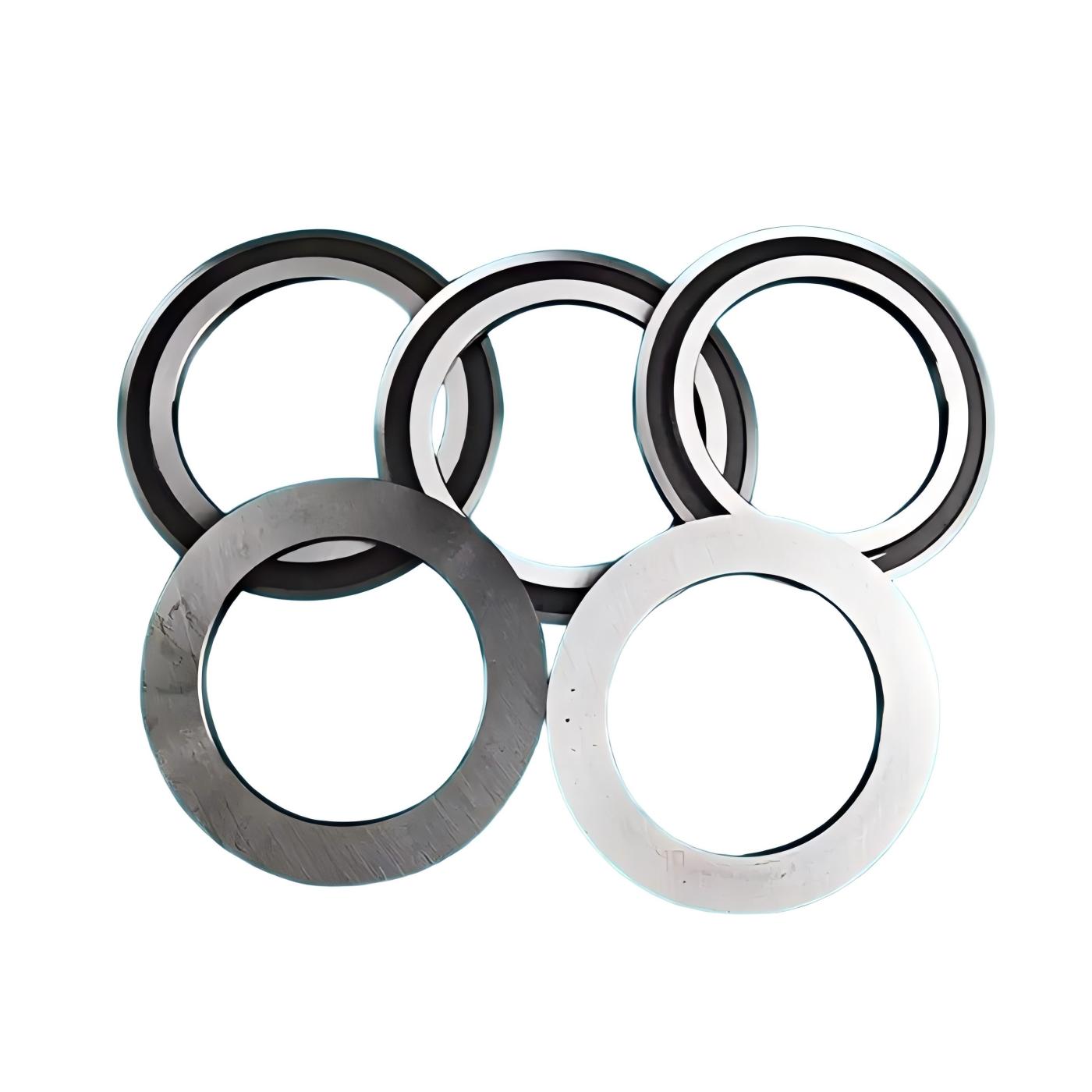
Precision coil slitting demands a dimensional tolerance standard that most industrial cutting applications never approach. On a high-speed slitting line running cold-rolled steel at 200–400 m/min across a 10-knife arbor stack, a cumulative thickness error of just 0.01mm per knife produces measurable slit-width deviation, visible burr height, and edge camber that exceeds the strip-steel quality limits for automotive body panel and appliance housing applications. Sureay circular metal slitter knives are manufactured to the following verified tolerance schedule, confirmed on a calibrated CMM before each shipment: | OD Range | OD Tolerance | Thickness Tolerance | Parallelism | |---|---|---|---| | ≤ 250 mm | +0.01 mm | ±0.001 mm | 0.001 mm | | ≤ 420 mm | +0.01 mm | ±0.001 mm | 0.002 mm | | ≤ 720 mm | +0.01 mm | ±0.005 mm | 0.003 mm | | ≤ 1600 mm | +0.01 mm | ±0.050 mm | Per drawing | All knife side faces are finish-lapped to Ra ≤ 0.2 μm. This mirror face finish is not aesthetic—it ensures full metal-to-metal contact between blades in the arbor stack, eliminating air gaps that allow individual blade deflection under lateral slitting load at high coil strip tension. ## Alloy Selection by Strip Material **Cold-Rolled Steel (CR, EG, HDG, HDGI):** D2 (1.2379) or SKD-11, hardened to HRC 60–62 via vacuum quench. High chromium carbide content resists the abrasive wear from zinc spangle and surface scale on galvanized and electrogalvanized coils. Recommended for CR steel service centres running continuous-shift slitting operations. **Hot-Rolled Steel & Structural Sections:** H13 (SKD-61) hot-work tool steel or 6CrW2Si for slitting heads operating at elevated ambient temperatures adjacent to pickling lines or in mill environments above 60°C ambient. **Silicon Steel (CRGO / CRNO Electrical Grade):** Cr12MoV or PM powder-metallurgy grades. Silicon steel's extreme abrasiveness—primarily caused by silica inclusions—demands maximum wear resistance to maintain slit-width tolerances throughout a full transformer laminate production run. Standard D2 loses edge profile within 10–15 coils on 0.35mm CRGO; PM-grade maintains dimensional specification for 50+ coils. **Copper & Brass Foil (C10100, C26000):** Low-alloy LD or M2 HSS grades. Softer non-ferrous substrates require edge geometry optimization to prevent material smearing and cold-welding to the knife face at high slitting speeds on close-tolerance coil widths. **Lithium Battery Electrode Foil (Copper Anode / Aluminum Cathode):** Solid carbide insert or PM-HSS grades with ISO Class 6 dimensional tolerances. EV battery electrode foils (8–12 μm thick) for gigafactory cell assembly require contamination-controlled handling and ultra-sharp edge geometry. Packaging in nitrogen-purged bags available on request. ## Complete Slitting System Supply The knife is only one component of a precision coil slitting system. Steel spacers, rubber bonded stripper rings, and overarm separator discs must be dimensionally matched to the knife set to ensure uniform arbor preload and consistent slit-width control across the full coil width. Sureay supplies integrated slitting tooling packages—knife set, spacers, stripper rings, and separators—verified as a matched system, eliminating the tolerance stack-up errors that accumulate when sourcing tooling components from multiple separate suppliers.
OEM AvailableMetal Shear Knives

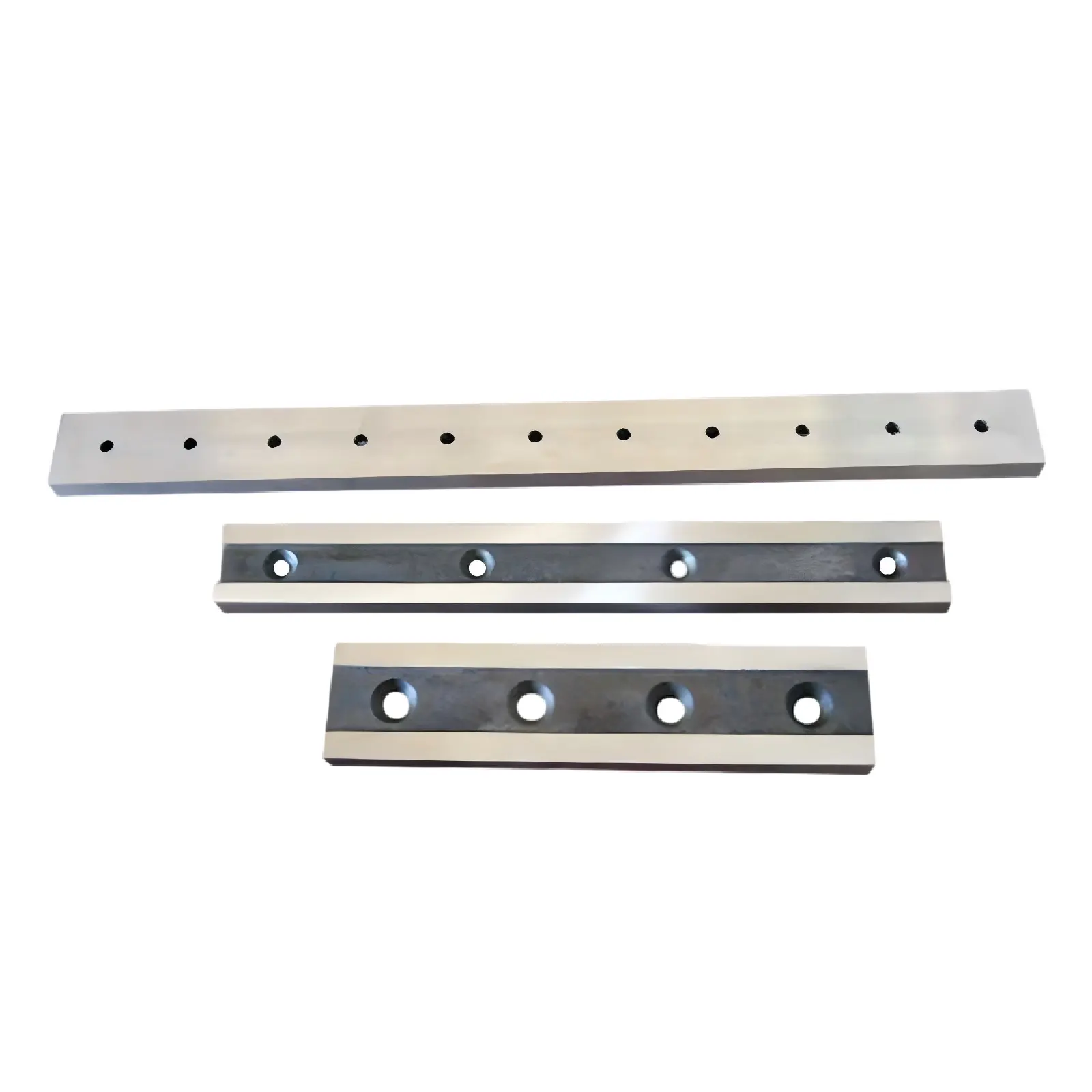
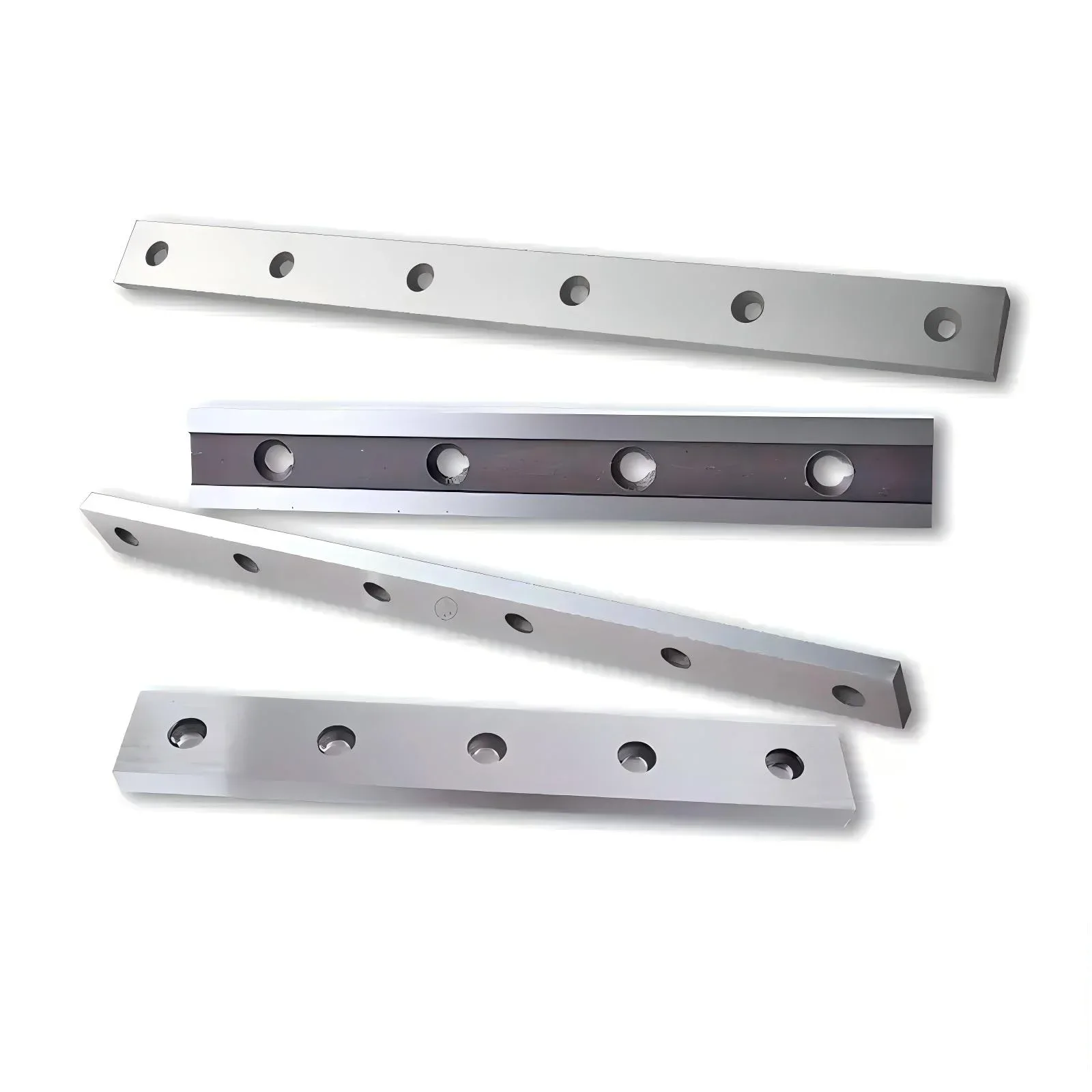
Guillotine shear blades operate under conditions that expose every weakness in alloy selection, heat treatment depth, and grinding parallelism. The upper shear blade is driven against the lower under actuator forces from 40 to over 2000 tonnes on heavy plate shearing lines. Premature failure modes—edge rollover on mild steel, brittle fracture on stainless, thermal softening on hot billet shears—are each attributable to a specific metallurgical mismatch or a grinding parallelism deviation that concentrates blade-to-blade contact at a single point rather than distributing it uniformly across the cutting length. Sureay guillotine shear blades are supplied in three metallurgical grades, each matched to a defined mechanical and thermal regime: ## Cold Shearing: T10, 65Mn — HRC 57–59 For standard A3/A36 mild steel plate up to 8mm thickness at ambient temperature. T10 high-carbon tool steel provides sharp, stable edge geometry at the lowest unit cost, making it the correct economical specification for general fabrication shops, structural steel contractors, and high-volume scrap recycling operations. 65Mn is the preferred choice for high-impact, high-cycle scrap bale shearing where bulk toughness outweighs abrasion resistance as the governing failure mode. ## Heavy Plate & Stainless Shearing: 9CrSi, Cr12MoV, 6CrW2Si — HRC 58–62 For stainless steel plate (304, 316L, 430, 2205 duplex), high-strength alloy plate (A514, Hardox 400, Domex 700), and galvanized sheet up to 20mm thickness on heavy hydraulic guillotines. 9CrSi provides a working balance of toughness and abrasion resistance for general heavy shearing duties. Cr12MoV (D2 equivalent) is specified for maximum wear resistance on austenitic stainless and hardox grades, where the chromium carbide matrix withstands the severe work-hardening wear imposed by high-nickel and high-manganese alloy steels. 6CrW2Si is used where elevated impact toughness is required alongside high hardness—particularly on structural plate shears processing blast-cleaned or rust-pitted surfaces. ## Hot Billet & Flying Shear: H13 (SKD-61), LD — High-Temperature Resistant For hot shears in steel rolling mills cross-cutting billets and slabs at material temperatures of 900–1100°C. H13 hot-work tool steel retains its hardness and structural integrity through its molybdenum and vanadium carbide lattice, resisting the thermal fatigue cracking and annealing that cause rapid edge rollover in cold-work grades within a single production shift. LD (low-alloy hot-work steel) is used for lower-temperature hot shearing, continuous flying shear applications, and split-beam shear installations where thermal cycling between cuts is the primary wear mechanism. ## Precision Grinding Standards Improper parallelism is the single most common preventable cause of premature shear blade failure. Uneven face contact concentrates the full shearing load onto a reduced length of blade edge, generating localized stress that exceeds the steel's compressive yield strength and produces edge rollover or chipping within hours. All Sureay shear blades are surface-ground on both cutting faces to: - **Standard tolerance:** ±0.05 mm parallelism over 1000 mm length - **Premium tolerance:** ±0.02 mm parallelism over 1000 mm length (specified for stainless steel, aerospace-grade aluminium, and precision structural applications) ## Supply Capability Single-piece blade lengths from 500 mm to 6000 mm. Multi-segment bolted designs for shear tables exceeding 4000 mm. Single-edge, double-edge (reversible), and quad-edge profiles according to the shear frame mounting geometry. OEM-matching dimensions are carried in standard stock or manufactured to drawing within 15 working days for TRUMPF TrumaBend, AMADA QC-67Y, BYSTRONIC Xpert, Durma AD, Haco Atlantic, and Zhiyi QC11Y/K hydraulic guillotine shear models.
OEM FitOEM AvailableBookbinding & Trimmer Knives
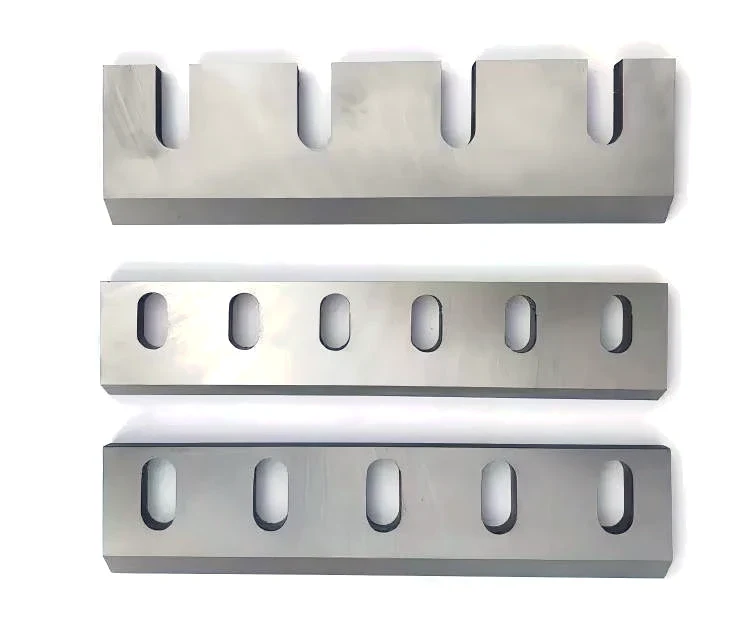
Industrial-grade replacement cutting blade sets designed to precise OEM specifications for high-speed Müller Martini three-knife trimmers (including 3671 Merit and 3675 Orbit). Each set contains one front knife and two side knives (left/right) manufactured to exact dimensional tolerances, featuring precise M10 threaded holes and mounting slots. Available in High-Speed Steel (HSS, industry equivalent to Duritan) and Tungsten Carbide (TC, equivalent to Widia/Hartmetal) for cutting all kinds of paper, boards, and materials with trouble-free bindery operation.
[ MANUFACTURING CAPABILITY ]
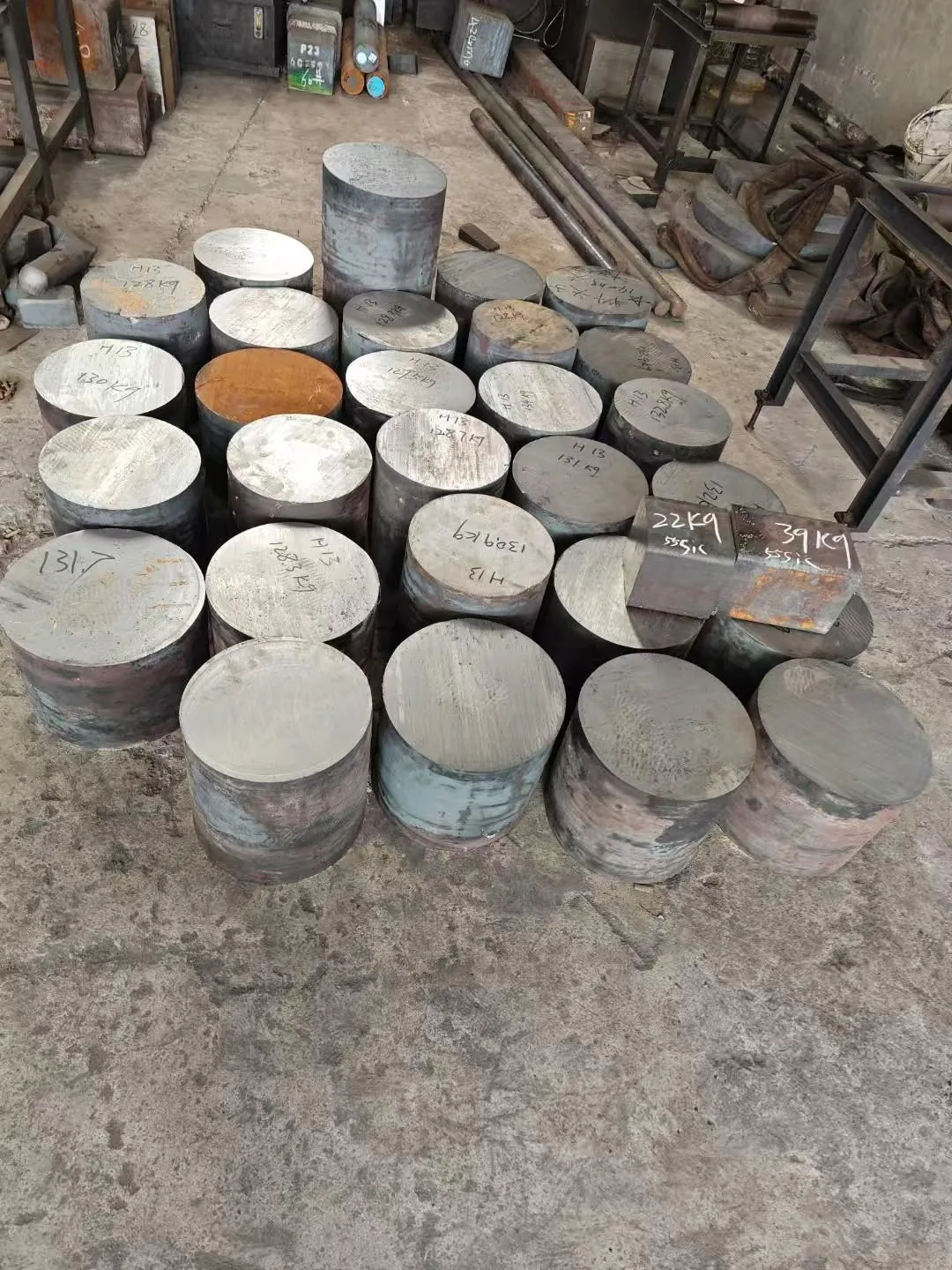
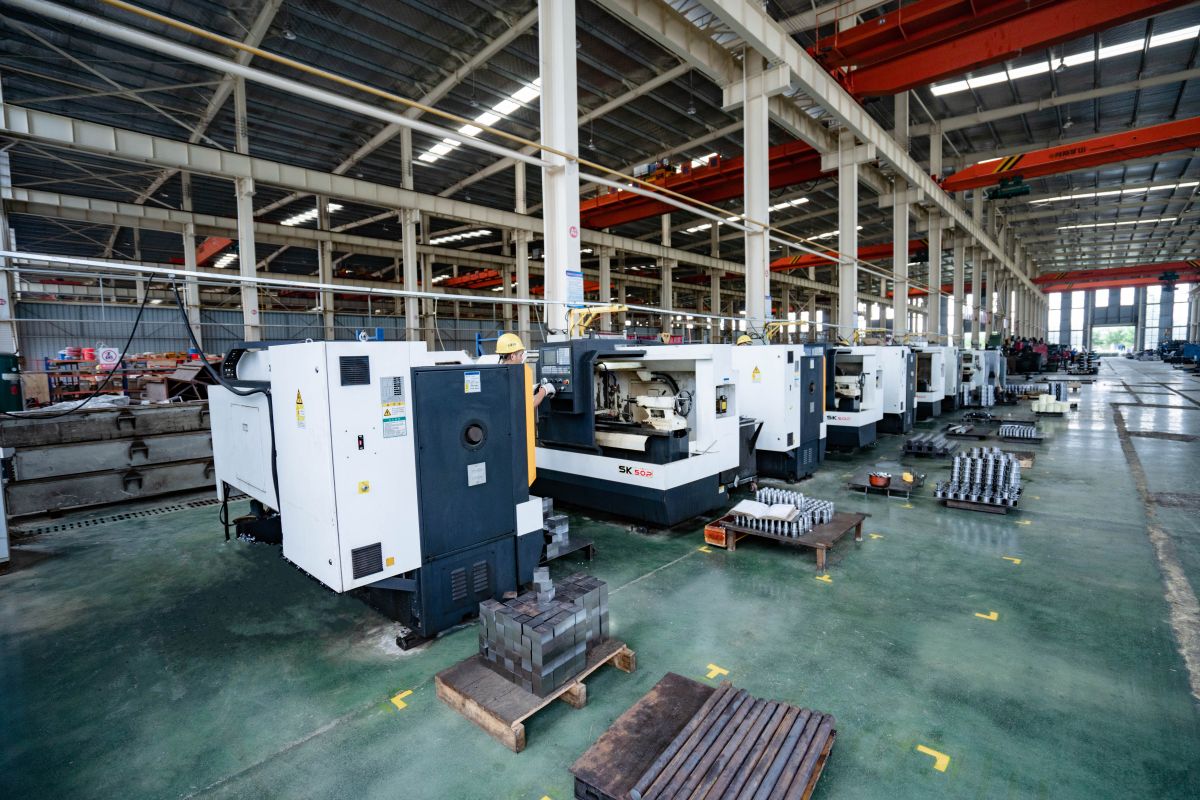
At Sureay, we don't just supply blades — we engineer cutting solutions. With over 15 years of experience in metallurgical processing and precision manufacturing, we produce high-performance machine knives for the recycling, paper converting, and plastic processing industries.
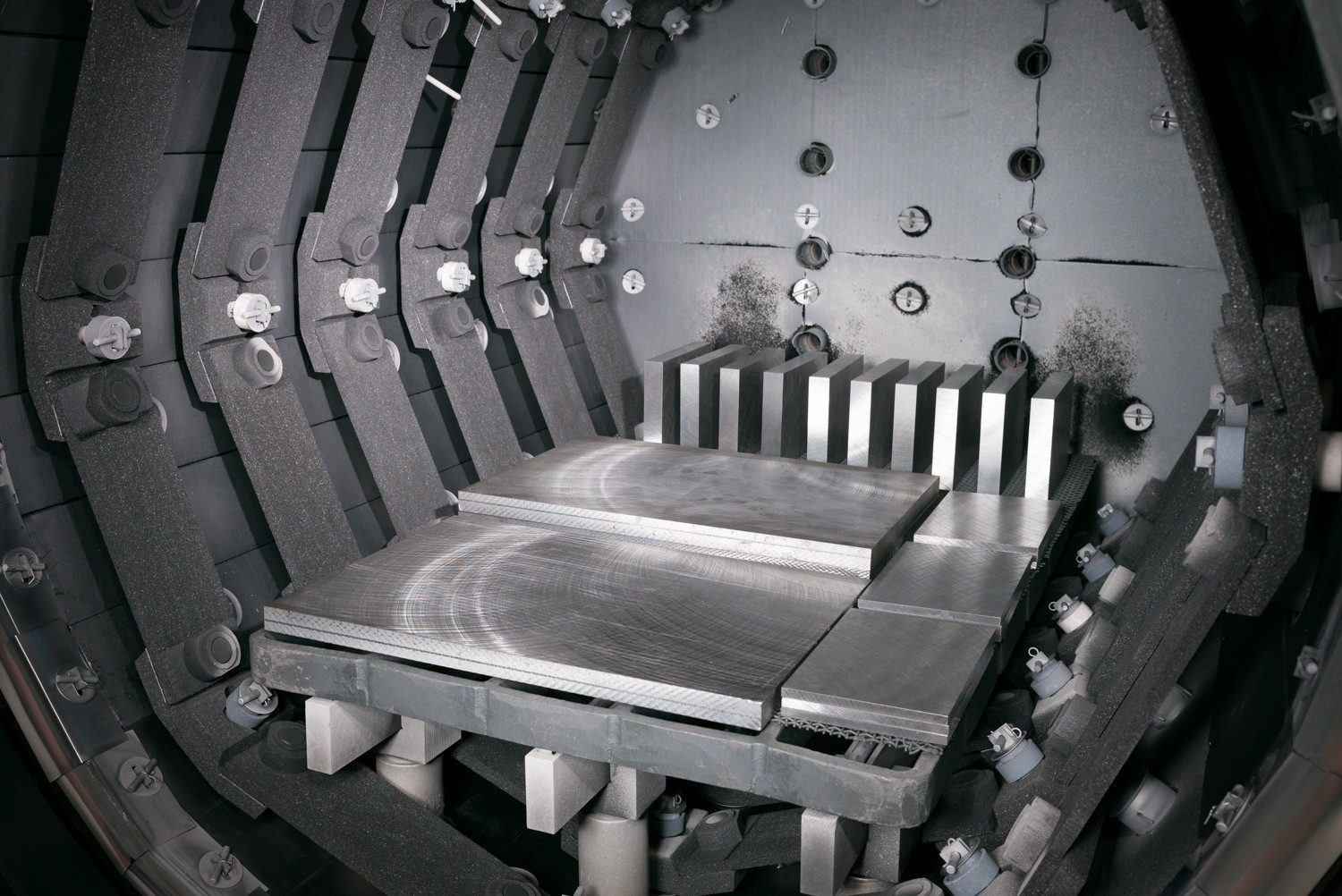
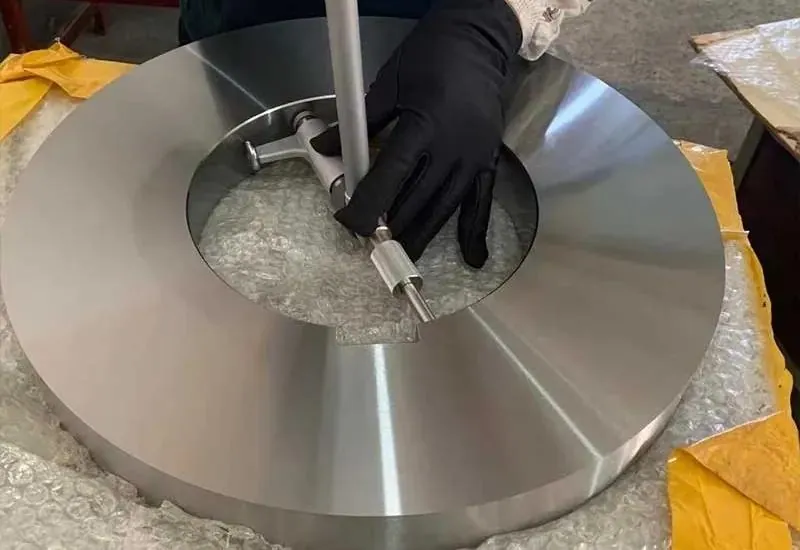
Whether you need high-wear shredder rotor knives, precision log saw blades, or custom guillotine shears, our in-house production ensures strict quality control from raw material selection to final edge grinding. Every batch undergoes rigorous CMM inspection to achieve the perfect balance of hardness and toughness.
Facility
15,000 m²
Founded
Est. 2008
Standard
ISO 9001
OEM Custom Manufacturing
A custom blade order moves through four clear steps — so you know what to send, what we confirm, and what gets checked before shipment.
Send your drawing, used sample, machine model, or key dimensions. We review the application, blade geometry, material being cut, and any known fit or wear issues from your current supplier.
Our engineers confirm steel grade, heat treatment direction, tolerance target, edge profile, and all OEM-fit details. Any open questions are resolved before quotation or production approval is issued.
The blade moves into CNC machining, vacuum heat treatment, and precision grinding in a controlled sequence. Each stage is tracked against the approved specification to prevent distortion and geometry drift.
Final dimensions, hardness, and edge condition are verified against specification before dispatch. The order is packed and shipped with the required inspection records, and material certification documents.
Send your drawing, used sample, machine model, or key dimensions. We review the application, blade geometry, material being cut, and any known fit or wear issues from your current supplier.
Our engineers confirm steel grade, heat treatment direction, tolerance target, edge profile, and all OEM-fit details. Any open questions are resolved before quotation or production approval is issued.
The blade moves into CNC machining, vacuum heat treatment, and precision grinding in a controlled sequence. Each stage is tracked against the approved specification to prevent distortion and geometry drift.
Final dimensions, hardness, and edge condition are verified against specification before dispatch. The order is packed and shipped with the required inspection records, and material certification documents.
Reach Our Team
Discuss your requirements directly with our engineers.
Our engineering team responds within 24 hours.
Cookie Settings
We use analytics cookies to understand how visitors use this site. No advertising or third-party data is shared. You can change your preference at any time.