
Premium Scraper Blades & Filter Plates for Continuous Melt Filters
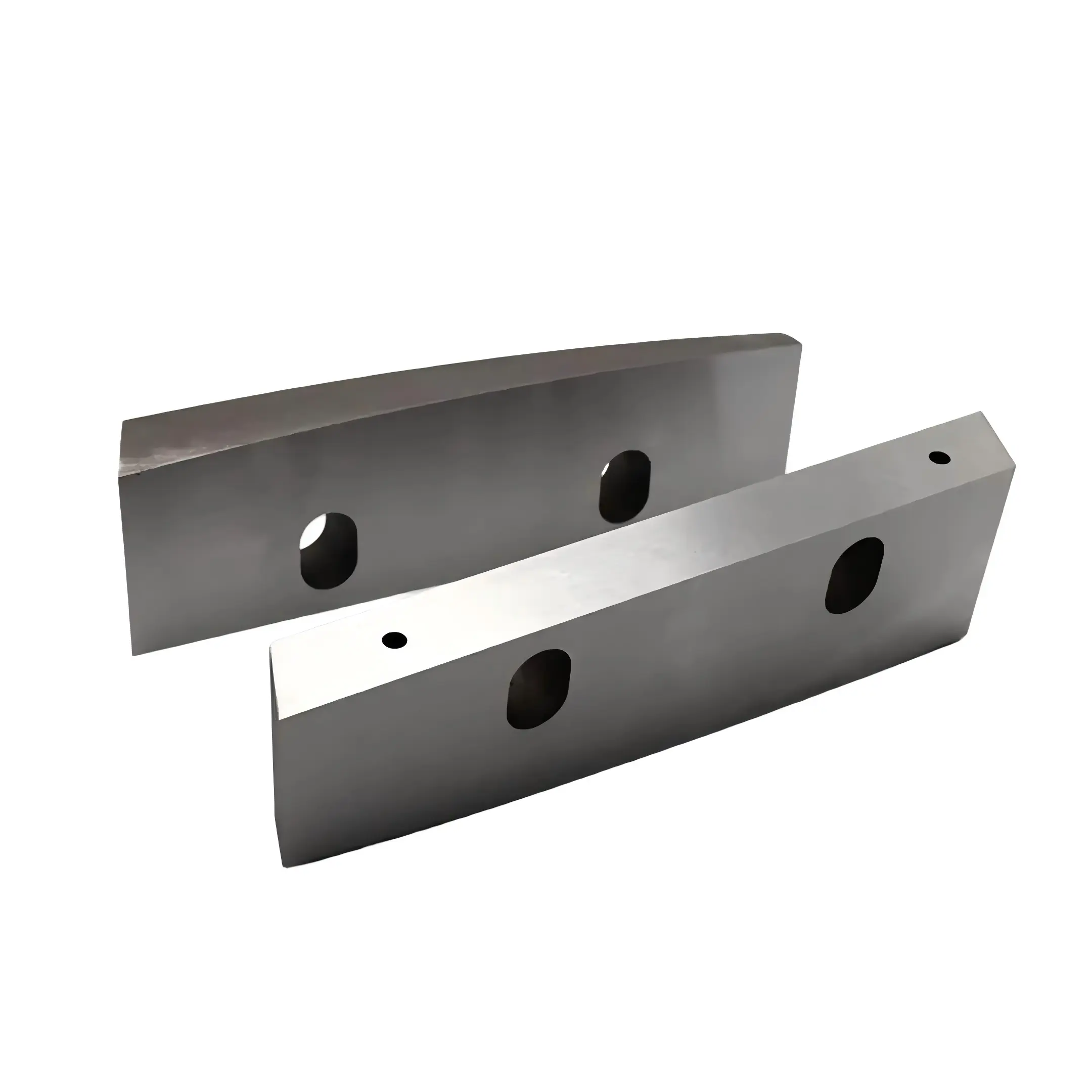
Melt Filter Scraper Blades
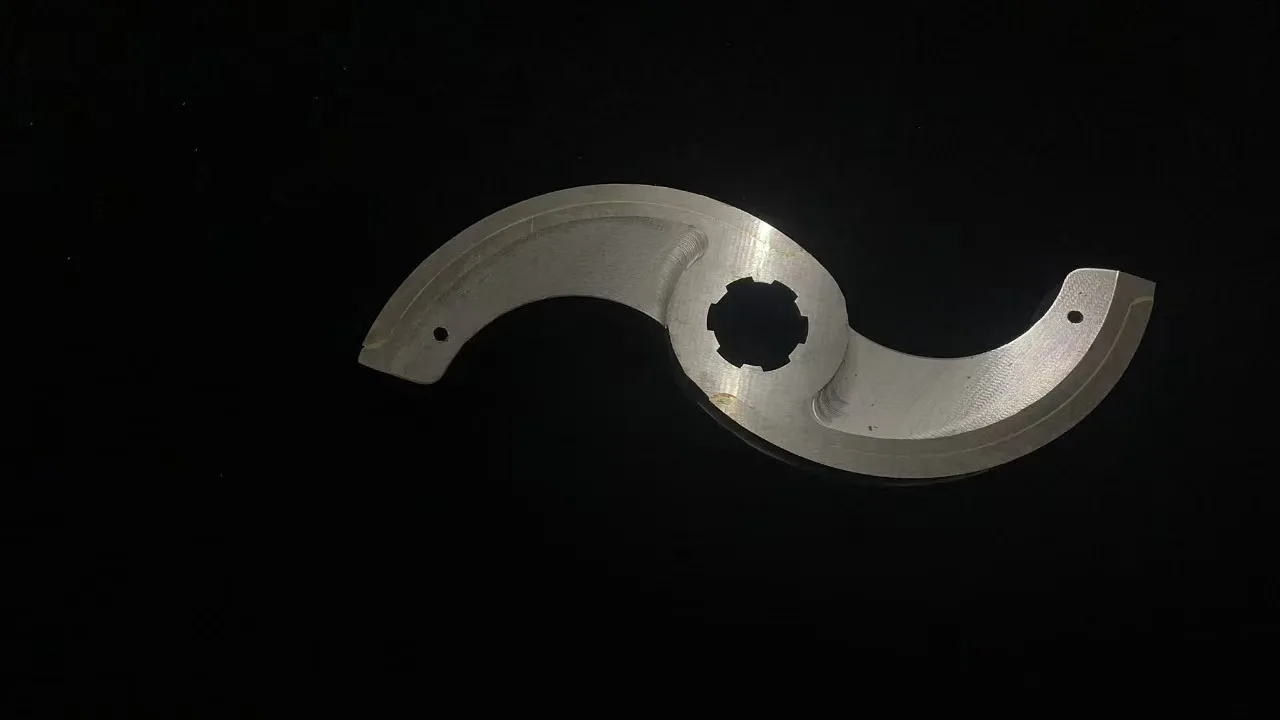
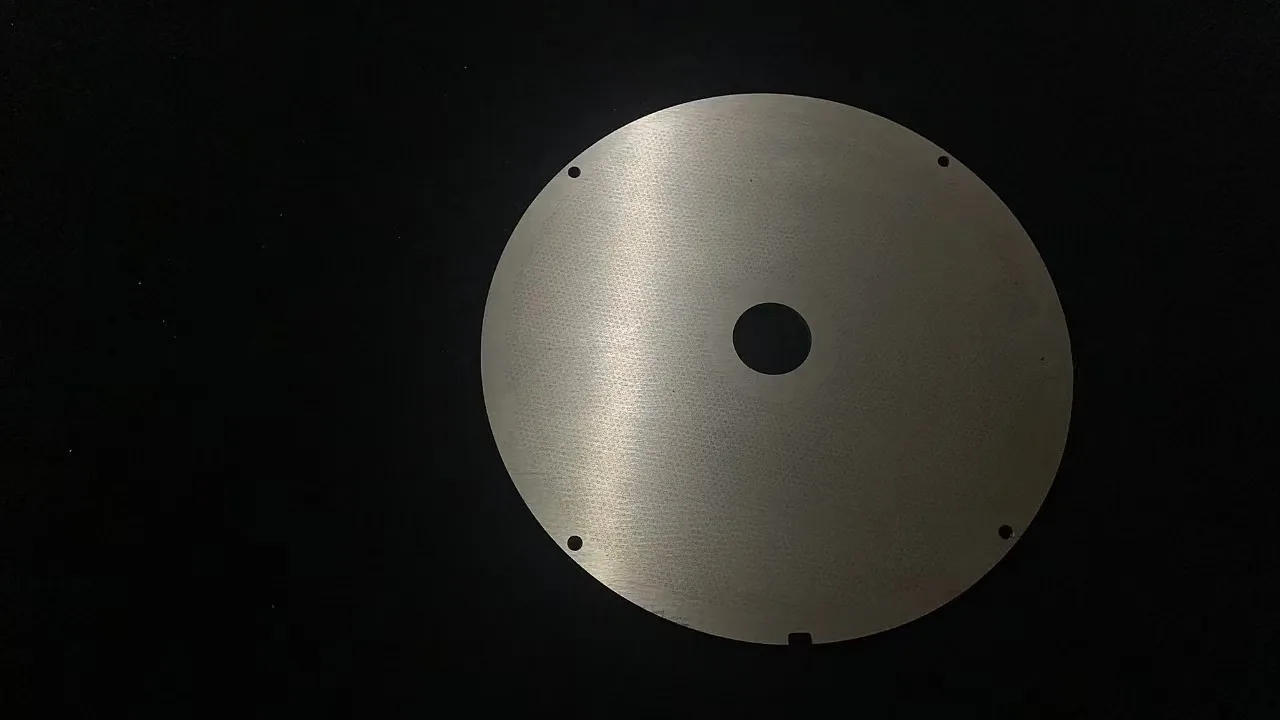
Precision D2/H13/Carbide scraper blades & laser-drilled conical filter plates for PCR continuous melt filters. Engineered hardness synergy (blade HRC 58–62 vs. plasma-nitrided plate HV 1,000+) protects filter plate capital investment. HCl-resistant alloys for PVC blends. Backflush-compatible with EREMA, Gneuß, Ettlinger & FIMIC.
- ■Material: D2 Tool Steel / H13 Hot-Work Steel / Solid Tungsten Carbide
- ■Applications: PCR HDPE/PP, Glass-Filled Compounds, PVC Blends, Agricultural Film, WEEE Plastics
■ ISO 9001:2015 Certified
■ In-House Heat Treatment
■ Strict Dimensional Tolerances
■ Global Door-to-Door Delivery
[ Engineering Reference ]
Decisive Specifications
| Material | D2 Tool Steel / H13 Hot-Work Steel / Solid Tungsten Carbide |
|---|---|
| Hardness Differential | Blade: HRC 58–62 (controlled-wear consumable) | Filter Plate Surface: Plasma Nitrided HV 1,000+ |
| Filter Plate Profile | Laser-drilled conical micro-perforations, 80–2,000 µm — tapered inlet expels contaminants, prevents polymer stagnation |
| Dimensional Tolerance | ±0.05 mm (blade profile) | ±0.02 mm (thickness) |
| Operating Temperature | Up to 300 °C (H13 / Carbide grades) |
| Corrosion Resistance | HCl-resistant alloys & barrier coatings for PVC and mixed-plastic melt outgassing |
| Applications | PCR HDPE/PP, Glass-Filled Compounds, PVC Blends, Agricultural Film, WEEE Plastics |
■ All values verified via CMM inspection · ISO 9001:2015
[ RFQ Prompt ]
Need a Specific Size or OEM Replacement?
Don't see your exact specs? Send us a blueprint, a worn sample, or just your machine model. Our team will review the details and provide a tailored quotation.
[ Standard Reference ]
Common Standard Dimensions
| Filter Model / OEM | Blade Length (mm) | Blade Width (mm) | Thickness (mm) |
|---|---|---|---|
| EREMA | 180 – 420 | 25 – 40 | 6 / 8 |
| Gneuß Rotary System | 150 – 380 | 20 – 35 | 5 / 8 |
| Ettlinger ERF 200/350 | 200 / 350 | 30 / 40 | 8 / 10 |
| FIMIC | 160 – 400 | 22 – 38 | 6 / 8 |
| Kreyenborg KSF | 200 – 500 | 30 – 50 | 8 / 12 |
| Nordson BKG | 150 – 350 | 20 – 35 | 5 / 8 |
[ OEM Compatibility ]
Compatible Machine Brands
® Registered trademarks are property of their respective owners. Sureay supplies compatible replacement blades — not OEM-branded parts.
[ Technical Audit ]
Engineering Advantages
Engineered Hardness Synergy
Filter plates are plasma nitrided to HV 1,000+ (≈ HRC 70+). Scraper blades are deliberately held at HRC 58–62. This verified differential makes the blade the controlled-wear consumable — it wears against the harder plate surface without scoring or gouging. Every shipment includes a hardness certificate confirming the blade is within range.
Conical Laser-Drilled Micro-Perforations
Tapered hole geometry (narrow inlet, wide outlet) exploits melt pressure to immediately expel contaminants rather than allowing them to stagnate inside cylindrical-wall holes. Prevents carbonization-driven hole blockage, maintains consistent differential pressure, and supports OEM backflush pulse dynamics at 150–400 bar without micro-cracking.
Diagnostic Upgrade Path
Edge chipping from tramp metal → upgrade to H13 or toughness-grade carbide. Progressive plate scoring → verify blade HRC certificate and bevel angle. Service life < 200 h on standard PCR → step to solid carbide for abrasion-dominated failure. Silent hole enlargement → specify PVD-coated corrosion-resistant PM plates for PVC-containing streams.
[ System Inventory ]
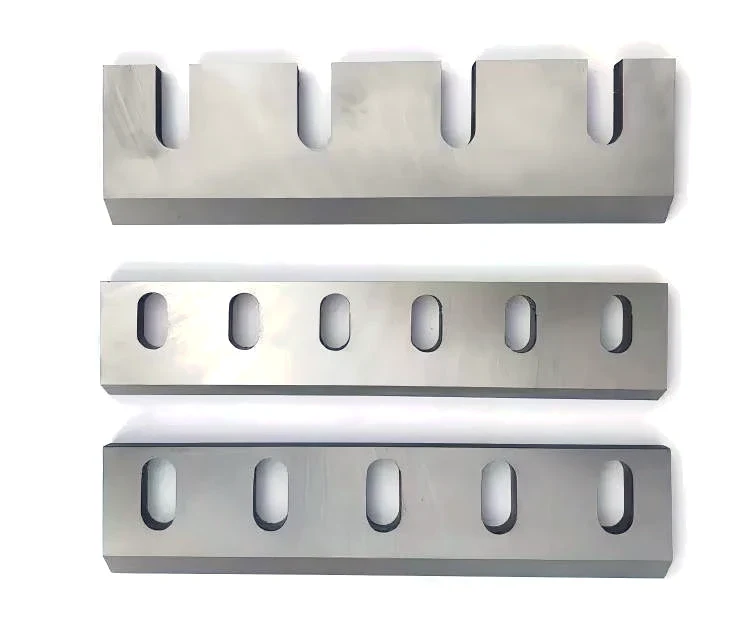
Related Blade Categories
View All →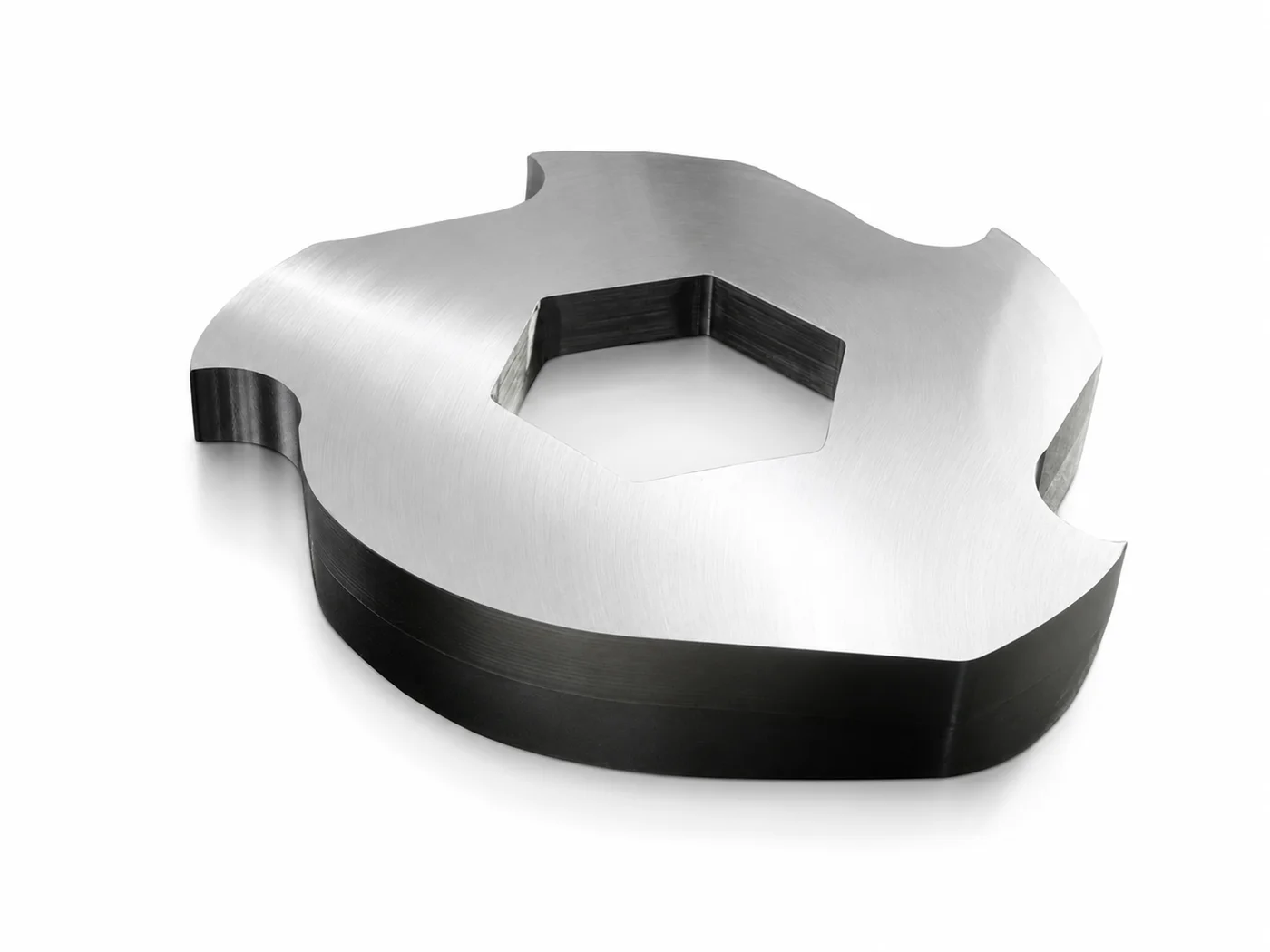
[ Knowledge Base ]
Product FAQs & Buying Guidance
Technical FAQs
01When should I upgrade from D2 to H13 for my scraper blades?
+−
When should I upgrade from D2 to H13 for my scraper blades?
Upgrade to H13 when your melt processing temperature consistently exceeds 260 °C, or when you are processing highly contaminated streams such as post-consumer agricultural film, WEEE plastics, or heavily printed packaging waste. These feedstocks generate significant thermal cycling stress that causes D2 to soften and lose edge geometry within 200–400 operating hours. H13's molybdenum-vanadium carbide matrix maintains hardness and dimensional stability up to 300 °C, extending scraper service life by 60–80% on these feedstocks.
02How does scraper blade wear affect melt pressure and throughput on a continuous filter?
+−
How does scraper blade wear affect melt pressure and throughput on a continuous filter?
A worn scraper blade leaves a residual contamination film on the filter screen surface after each rotation. This film progressively reduces the effective open screen area, causing melt pressure to rise and throughput to fall. On a heavily loaded PCR line, a blade worn beyond its service limit can cause a 15–25% throughput reduction and accelerate screen clogging to the point of breakthrough failure. Monitoring melt pressure differential across the filter is the most reliable wear indicator — we recommend blade inspection when differential pressure rises more than 20% above baseline.
03What filtration fineness should I specify for recycled HDPE and PP pellet production?
+−
What filtration fineness should I specify for recycled HDPE and PP pellet production?
For standard PCR HDPE and PP pellet production targeting film or injection moulding applications, specify 300–500 µm filtration fineness. This removes hard particles that cause die-face streaking and surface defects without excessive pressure drop on moderately contaminated feedstock. For food-grade contact recycled resin (rHDPE, rPP under EU 10/2011), specify 150–200 µm to meet the stricter contamination removal requirements. For highly contaminated agricultural film or MSW-derived feedstock, start with 500–800 µm to manage pressure and step down as the input quality improves.
04Will high-hardness aftermarket scraper blades score or damage my filter plates?
+−
Will high-hardness aftermarket scraper blades score or damage my filter plates?
This is the most important question to ask any aftermarket blade supplier. Sureay engineers a deliberate hardness differential: filter plates are plasma nitrided to HV 1,000+ (approximately HRC 70+), and scraper blades are manufactured to a strictly controlled HRC 58–62. The blade is always softer than the plate surface — it functions as a controlled-wear consumable that gradually wears away without generating metal-transfer scoring or gouging on the harder plate face. Every shipment includes a Rockwell HRC test certificate confirming the blade is within this range. If a supplier cannot provide this certificate, you have no guarantee the hardness differential is correct.
05Are Sureay filter plates compatible with automated backflushing on Ettlinger and Gneuß systems?
+−
Are Sureay filter plates compatible with automated backflushing on Ettlinger and Gneuß systems?
Yes, fully compatible. Sureay filter plates are designed and FEA-validated for OEM-rated backflush pulse pressures (typically 150–400 bar on Ettlinger ERF and Gneuß RSFgenius systems). The conical laser-drilled hole geometry enhances backflush efficiency: the wider downstream outlet acts as a nozzle that accelerates the reverse pulse through each perforation, improving contaminant ejection versus cylindrical-hole plates. Hole array layout and plate dimensions replicate OEM specifications exactly — no recalibration of backflush timing, pressure, or controller parameters is required after installation.
06My filter is losing filtration quality without a differential pressure alarm. How do I diagnose this?
+−
My filter is losing filtration quality without a differential pressure alarm. How do I diagnose this?
This is the symptom of silent hole enlargement — a failure mode where filter plate micro-perforations gradually widen due to chemical corrosion of the hole walls rather than mechanical wear. Enlarged holes allow oversized contaminant particles through while maintaining low differential pressure because the wider holes offer less resistance. The root cause is almost always HCl outgassing from PVC or organochlorine contamination in the feedstock reacting with standard tool steel at melt temperatures. Confirm by: (1) measuring output melt contamination particle size — if oversized particles are present without pressure rise, hole enlargement is confirmed; (2) inspect a removed plate under magnification for hole-wall pitting or rounding. The solution is to specify Sureay PVD-coated, corrosion-resistant PM steel filter plates, which seal the micro-perforation walls against acid diffusion and prevent the insidious progressive enlargement.
07Can Sureay match our existing EREMA or Gneuß scraper blade dimensions?
+−
Can Sureay match our existing EREMA or Gneuß scraper blade dimensions?
Yes. Send us your existing blade sample or the OEM part number and machine model. We will dimensionally verify the blade profile on our CMM, confirm the mounting interface, edge bevel angle, and material specification, and supply direct drop-in replacements. For EREMA Continuous Filter and Gneuß Rotary Filtration Systems, we maintain reference drawings for the most common platform sizes. Lead time for standard replacement blades is 7–12 working days from dimension confirmation.
08How many operating hours can I expect from D2 scraper blades on a mixed PCR line?
+−
How many operating hours can I expect from D2 scraper blades on a mixed PCR line?
On a mixed PCR rigid plastics line (HDPE/PP, < 3% mineral contamination, melt temperature 230–260 °C), D2 scraper blades typically deliver 400–700 operating hours before the edge profile degrades to the point of rising differential pressure. H13 blades on the same line extend service intervals to 600–1,000 hours. On highly abrasive streams (glass-filled compounds, agricultural film with embedded soil), D2 service life drops to 150–300 hours; H13 extends this to 250–450 hours; solid carbide delivers 1,000–2,000+ hours on these feedstocks.
Why Choose Sureay
01Are your melt filter scraper blades direct OEM replacements or aftermarket parts?
+−
Are your melt filter scraper blades direct OEM replacements or aftermarket parts?
They are precision aftermarket replacements manufactured to OEM dimensional specifications. We reverse-engineer each blade from OEM drawings or customer samples, verify fit on a CMM, and supply with a dimensional inspection certificate. Our blades are not rebranded OEM parts — they are manufactured directly in our facility using premium D2, H13, or carbide materials with our full quality documentation package.
02What quality documentation is included with scraper blade shipments?
+−
What quality documentation is included with scraper blade shipments?
Every shipment includes: Rockwell HRC hardness test certificate, CMM dimensional inspection report confirming edge profile and mounting interface tolerances, steel mill material traceability certificate, and heat treatment batch certificate. For customers requiring enhanced documentation for ISO 9001 or recycling process qualification, full material test reports and process records are available on request.
Reach Our Team
Get in Touch with Our Engineers
Contact Our Team
Discuss your requirements directly with our engineers.
Request a Quote
Our engineering team responds within 2 hours.