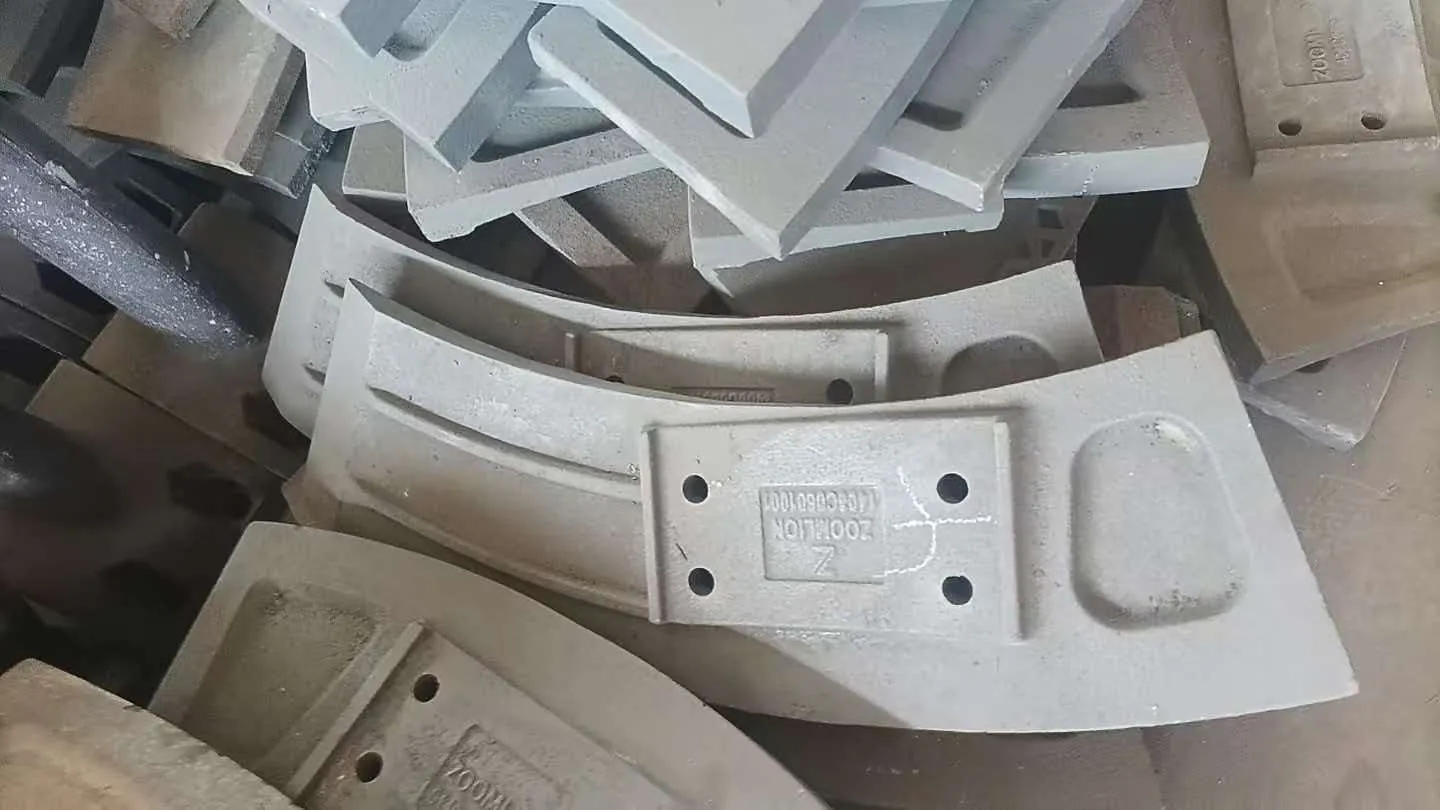
Ni-Hard vs high-chrome iron vs wear plate: what each material actually is
Ni-Hard is a family of nickel-alloyed white irons. High-chrome iron, also called high chromium white iron, describes another broad group of carbide-bearing cast irons. Neither name specifies the full chemistry, heat treatment or final properties.
Wear plate is even less specific. It may mean quenched-and-tempered abrasion-resistant steel, chromium carbide overlay on steel, or cast white iron bonded to a steel backing. These constructions behave differently during fabrication and service.
| Material | What it is | Published hardness example | Main strength | Main limitation |
|---|---|---|---|---|
| Ni-Hard | Alloyed white-iron casting | Ni-Hard 1: 550–690 BHN, section-dependent | Abrasion resistance in cast shapes | Limited tolerance of bending and fracture |
| High-chrome iron | Chromium-carbide-bearing casting | Hardened 25% Cr example: 600–700 HB | Severe abrasive-wear capability | Performance depends on matrix and carbide structure |
| Q&T wear steel | Heat-treated solid steel plate | Hardox 400: 370–430 HBW; Hardox 500: 470–530 HBW for listed plate ranges | Toughness and fabrication flexibility | May sacrifice abrasion life against harder alternatives |
| Carbide overlay | Weld-deposited hard layer on steel | Duroxite 100, overlay over 5 mm: 59–64 HRC | Abrasive protection on a fabricable backing | Hard layer has impact and forming limits |
| Bi-metal | Cast white-iron face bonded to steel | Published Cr-Mo composite face: approximately 700 HB | Hard wear face with an attachable backing | Face and bond both need suitable loading |
These are product examples, not universal grade limits or Sureay specifications. HRC and Brinell numbers use different scales. Sources: Ni-Hard 1 chemistry and hardness, 25% chromium iron delivery conditions, Hardox steel grade specifications, Duroxite 100 overlay specifications, Adamiak et al., tested composite construction.
Specify the applicable standard, class, type and delivery condition. ASTM A532 covers alloyed abrasion-resistant white irons; it explicitly excludes simple and low-alloy pearlitic white irons. Order a defined class and condition rather than “ASTM A532 wear iron” alone. ASTM A532 scope
ASTM A532 grades used in mixer wear-part specifications
Class I includes the nickel-chromium Ni-Hard family: Type A is commonly identified as Ni-Hard 1, Type B as Ni-Hard 2 and Type D as Ni-Hard 4. Class II covers chromium white irons, including Type B, designated 15% Cr-Mo. Class III Type A is designated 25% Cr. These are specification families, not interchangeable product names; confirm the type and heat-treated condition on the quotation. Nickel Institute Ni-Hard grade guide, foundry grade classifications.
What wears a concrete mixer liner: abrasion vs impact
Aggregate and fines slide, roll and become trapped between working surfaces. Occasional oversize stone or tramp metal adds a different problem: concentrated impact or jamming.
Moving blade edges and scraper tips are sensible inspection priorities, but they do not universally wear faster than every floor or side liner. Position, clearance and material flow determine local exposure. Map the wear before assigning one alloy to the whole mixer.
Record aggregate mineralogy and size, mix recipe, mixing time, throughput and removal reason. Low-slump or UHPC production can change resistance and contact conditions; a high-output plant also accumulates exposure faster. Use those details to select the wear material and plan replacement stock around your maintenance schedule.
Start with the failure mode: select abrasion resistance for gradual thinning, and investigate support and toughness when useful thickness remains at fracture.
Ni-Hard concrete mixer liners for predictable abrasive wear
Choose Ni-Hard for repeatable concrete mixer liner plates and paddle geometries in abrasion-dominated service, especially where the grade already has a reliable operating history. Established patterns also simplify repeat orders and dimensional consistency.
Grade selection matters. Ni-Hard 1 has more carbon and carbide than Ni-Hard 2; the latter trades some abrasion resistance for improved toughness. Ni-Hard 4 has a different alloy balance, including approximately 7–11% chromium. It is not simply the same material with a higher hardness number. Nickel Institute technical guide
Specify a proven Ni-Hard grade for predictable abrasive duty and repeatable replacement geometry. Investigate an upgrade when abrasion drives frequent stops. If castings instead crack near fixings or unsupported areas, examine seating, loading and casting quality alongside the replacement material specification.
High-chrome mixer liners for severe abrasive service
Select high-chrome iron for supported liners and replaceable concrete mixer blade tips exposed to sustained abrasive material loss. Its carbide-bearing structure can be valuable where abrasive aggregate is consuming the existing wear face too quickly.
However, “more chromium means more wear resistance and less toughness” is too simple. Carbon balance, carbide size and distribution, matrix condition and heat treatment all affect the result. In one study, an alloy that performed well in sliding and slurry abrasion performed poorly in erosion. Composition and wear study
Specify the grade and final condition. For one published 25% Cr alloy, hardness changes from 450–550 HB as cast to 600–700 HB after hardening. The chemistry label alone does not tell you what is being delivered. 25% Cr iron hardness before and after heat treatment
For severe abrasive thinning, specify high-chrome iron with an agreed heat treatment and finished hardness range.
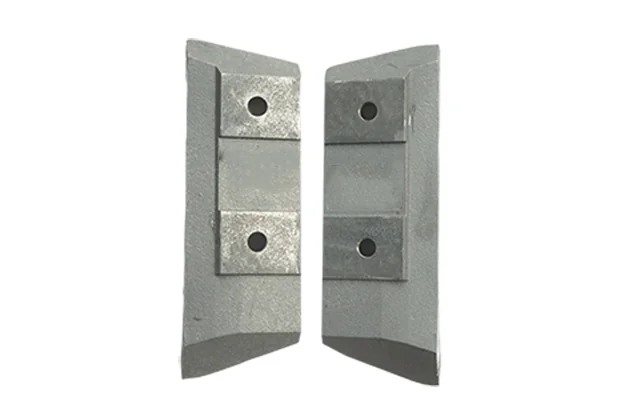
Wear plate for mixers: Q&T steel vs carbide overlay vs bi-metal
Solid Q&T steel is the natural starting point when toughness, bending or fabrication access dominates. AR400/AR500 labels describe hardness classes; purchase against the actual mill specification. Hardox is SSAB’s brand, with several grades, not a synonym for every wear steel.
Carbide overlay puts a hard welded deposit on a supporting plate. It suits abrasive service where the selected deposit tolerates the impact. Cutting, forming and attachment must account for both layers. Surface relief checks are not equivalent to through-cracks in the backing. Overlay product and fabrication guidance
Bi-metal combines a cast wear face with a steel backing. The backing provides an attachment route; it does not make the hard face ductile. Confirm bond quality, support and attachment details. Cr-Mo white-iron/steel composite described by Adamiak et al.
Do not assume any plate option is automatically lighter. Compare the finished assembly’s area, thickness, backing and reinforcement. Steel’s fabrication flexibility is useful; the same ease of welding or forming cannot be assigned to every overlay or bi-metal product.
Choose solid Q&T steel for impact and fabrication needs; choose overlay or bi-metal when a supported hard wear face and steel attachment are required.
Concrete mixer liner materials compared
Every cell below is general selection guidance, not a measured ranking or performance guarantee.
| Factor | Ni-Hard | High-chrome iron | Q&T steel | Carbide overlay | Bi-metal |
|---|---|---|---|---|---|
| Abrasion life | Strong cast-liner baseline | Trial for severe sliding abrasion | Higher-hardness grades offer an upgrade path | Life depends on usable hard-layer thickness | Hard face must remain supported and bonded |
| Impact tolerance | Grade matters; avoid bending | Protect against shock and bending | Preferred shortlist for impact duty | Conventional deposits favour lower impact | Steel backing does not prevent face chipping |
| Weight | Casting thickness controls mass | Casting thickness controls mass | Compare required finished thickness | Count both deposit and backing | Count both casting and backing |
| Repairability | Routine weld repair is difficult | Do not assume weld repair | Cutting and welding with a grade-specific procedure | Backing attachment; qualified resurfacing | Attach through backing; respect face restrictions |
| Order specification | Confirm pattern and casting grade | Confirm chemistry and heat treatment | Confirm mill grade and fabrication procedure | Specify deposit and backing thickness | Specify wear face, backing and bond quality |
| Best use | Established abrasion-duty castings | Supported severe-wear zones | Tough, fabricated components | Broad supported sliding-wear surfaces | Hard-face assemblies needing steel attachment |
Best material for each mixer part: liners, blade tips, arms and scrapers
Use the component’s job to build the shortlist, then check the design and service evidence.
| Component | Practical selection starting point |
|---|---|
| Side and floor liner plates | Compare proven Ni-Hard with high-chrome for abrasive thinning; evaluate steel where toughness or fabrication is decisive. |
| Replaceable mixer blade tips | Trial abrasion-resistant cast grades when edge loss controls replacement; reassess toughness and support if tips chip early. |
| Concrete mixing arms | Specify the required structural strength, toughness and fatigue capability. A hard replaceable tip does not justify making the entire arm from brittle wear iron. |
| Concrete mixer scrapers | Balance edge retention with jamming, support and adjustment requirements; inspect the holder as well as the wear edge. |
| Discharge doors | Separate the load-bearing door structure from its sacrificial wear face; preserve travel, sealing and clearance. |
Hard, angular aggregate strengthens the case for an abrasion-focused trial. Low-slump and UHPC recipes require attention to the actual mixing cycle and loading. High annual output increases the value of avoiding a shutdown. None of these modifiers makes one grade correct for every position.
Ni-Hard vs Hardox wear life: why claims of 3× and 9× differ
Two published comparisons measure different things:
- MEKA claims up to three times the wear life for Ni-Hard against Hardox materials. The brochure passage does not establish a universal grade-by-grade test. MEKA single-shaft mixer brochure: Ni-Hard wear-life claim
- A 2009 study reported approximately nine times the abrasion resistance against Hardox 400. Its specimen was Cr-Mo white iron bonded to steel, tested with dry quartz sand under ASTM G65 Procedure A. Average volume losses were 15.3170 versus 138.8705 mm³. That is a laboratory comparison, not nine times the concrete output between shutdowns. Adamiak, Górka and Kik (2009), ASTM G65 abrasion comparison
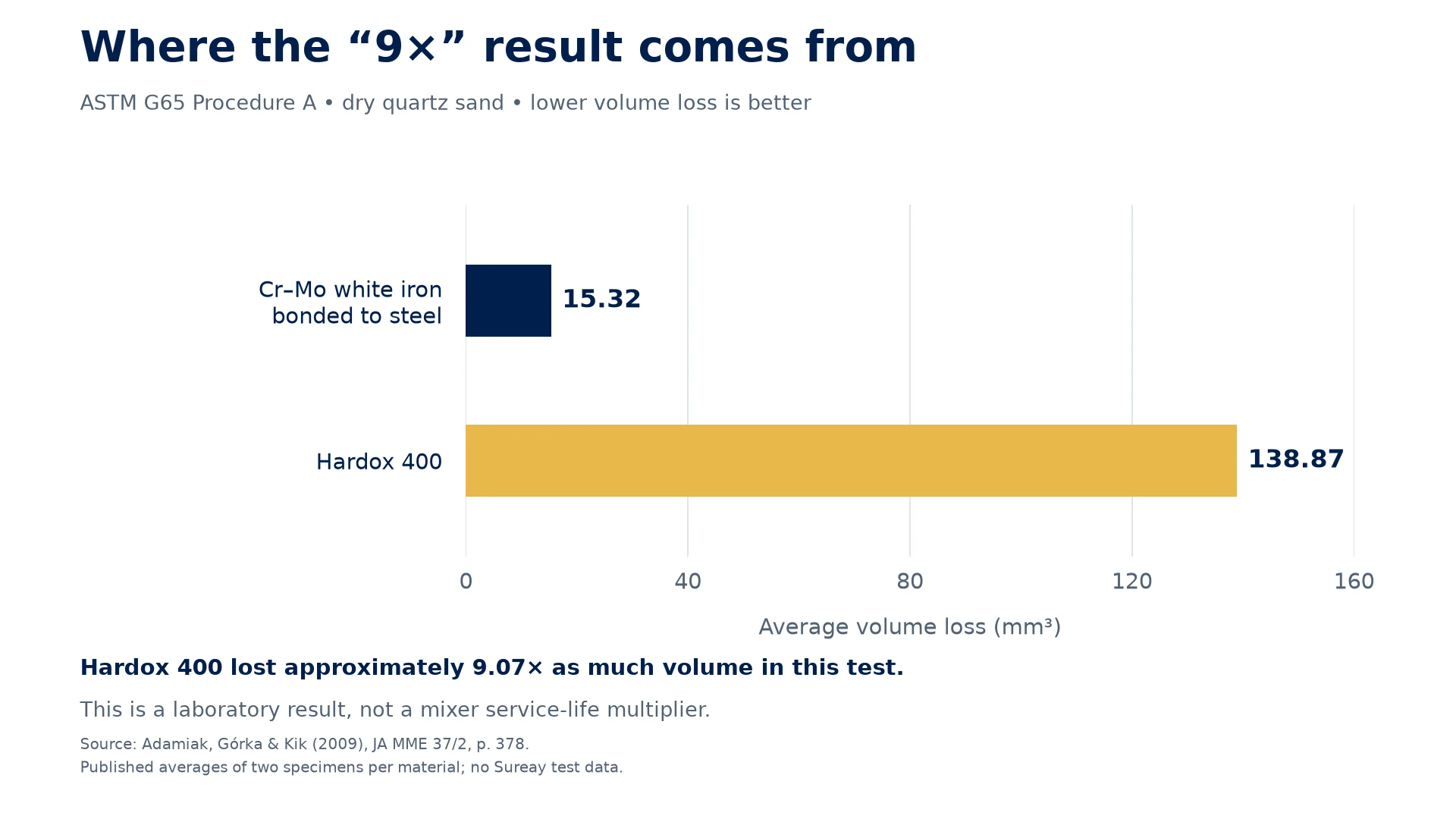
Hardness is useful within a defined alloy and condition. Across different structures, it cannot capture carbide support, fracture or the abrasive interaction. Ask which grade was tested, against what abrasive, at what load, and whether the result measures mass loss, volume loss or actual service output.
Use published tests to guide the material shortlist, then match the specification to your own mixer position and operating conditions.
Get more value from your concrete mixer wear parts order
A well-specified wear-parts order supports reliable production in three practical ways: the wear material suits the aggregate, the replacement fits the mixer, and the next set is ready for a planned maintenance window.
- Plan for fewer unplanned interruptions. Match the liner grade to the wear mechanism and inspect high-wear positions on a consistent schedule. Arrange replacement stock before wear reaches the agreed removal limit.
- Prepare for efficient changeovers. Confirm hole spacing, seating faces, orientation and the required hardware before delivery. Group compatible liners, blades and scrapers into a clearly identified maintenance set.
- Make repeat supply straightforward. Keep the approved drawing revision, part number, material and component position together. These details give the next order a clear specification and help prevent mismatched parts reaching the workshop.
For plants running several mixers, identify each set by machine and position. Send Sureay the equipment list and planned maintenance dates so the enquiry can cover both immediate replacements and repeat-order requirements.
Specify concrete mixer replacement parts with Sureay
Sureay’s published range includes Ni-Hard and high-chrome iron liner plates, Ni-Hard mixing blades, high-chrome scrapers and ZG310-570 cast-steel mixing arms. Replacement enquiries can be matched using the OEM model, part number, drawing or worn sample. Material choice and dimensional identification should be reviewed together.
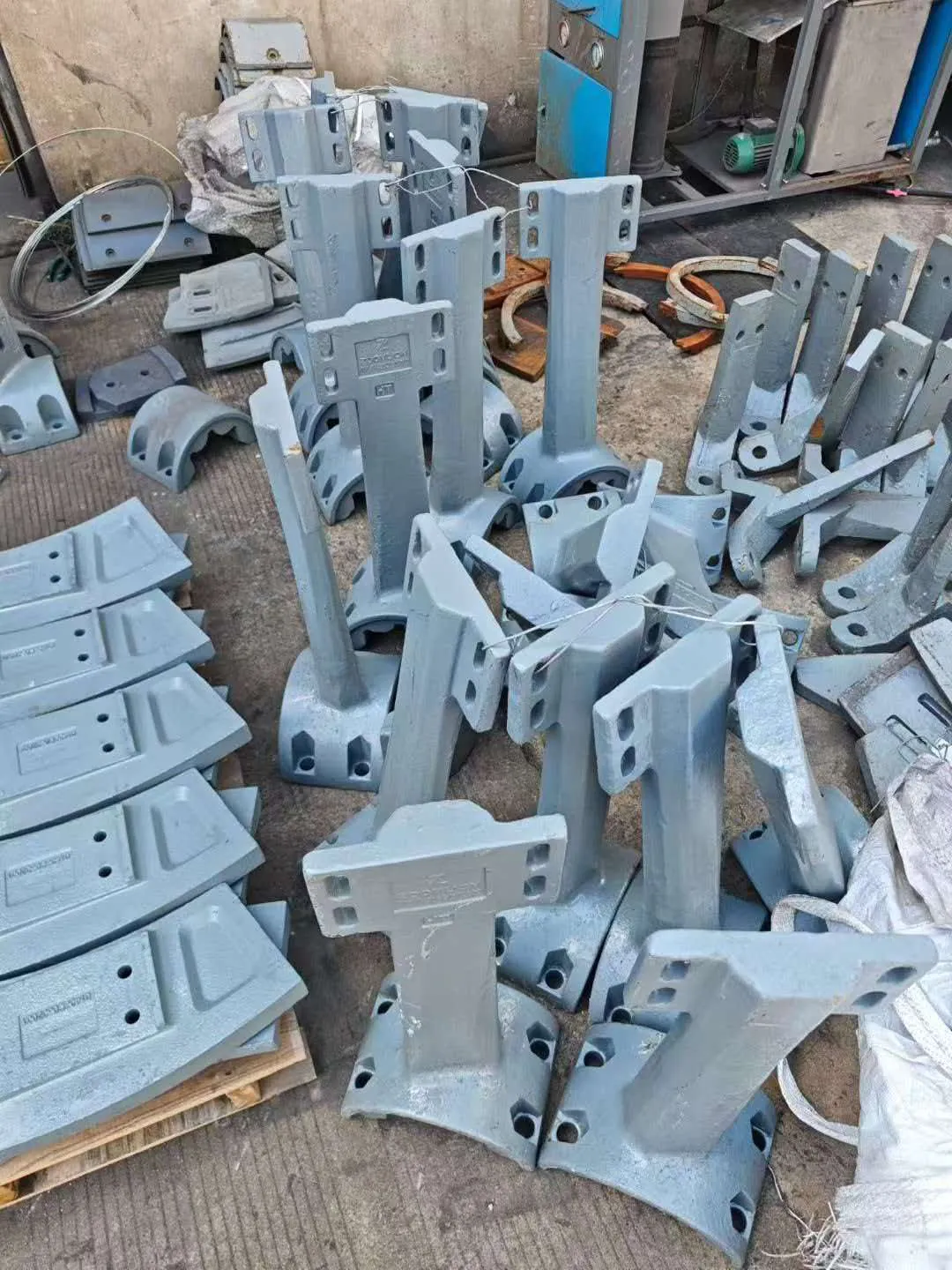
For a practical quotation, include:
- Mixer brand, model, part number and installation position.
- Drawing or clear photographs with the mounting dimensions and orientation.
- Aggregate type, maximum size, mix recipe and the current wear or fracture pattern.
- Required material or applicable standard, quantity and target delivery date.
- Any batch chemistry, hardness-test or inspection-document requirements, to be confirmed in the quotation.
Use our concrete mixer wear-parts guide to identify the component category. Send the part information and operating conditions together so Sureay can review fitment and material requirements in one enquiry.
Concrete mixer liner material FAQ
What is the best material for concrete mixer liners?
Ni-Hard and high-chrome white iron are strong choices for supported liners dominated by abrasive thinning. Choose Q&T wear steel when impact tolerance or fabrication is decisive. Overlay and bi-metal suit specific designs needing a hard face on a steel backing. Select by wear mechanism, component geometry and mounting conditions.
How long do concrete mixer liners last?
Service life depends on aggregate hardness and size, mix recipe, mixing time, throughput, liner position, clearance and material condition. Record starting thickness and repeat measurements at fixed locations; log concrete output and the reason for replacement. This creates a useful maintenance interval for that machine without relying on a generic month count.
Ni-Hard vs high chrome: which is harder?
Published ranges overlap: the cited Ni-Hard 1 example is 550–690 BHN, while the hardened 25% chromium iron example is 600–700 HB. Neither family is always harder. Compare the specified grade, heat treatment, casting section and test method; hardness alone does not rank abrasion life.
Is Ni-Hard better than Hardox for a mixer?
Choose Ni-Hard for abrasion-dominated cast liner geometries. Choose a suitable Hardox or other Q&T steel grade for tougher fabricated components. Hardox 400 and Hardox 600 are different materials, so a result against one grade should not be applied to the whole brand.
Can I mix materials in one mixer?
Yes, when the component design permits it. Tough steel arms can support hard replaceable wear tips, while liners use an abrasion-focused grade. Confirm geometry, running clearances and mounting details before changing material at a particular position.
Why do cast liners crack?
Impact, poor seating, mounting stress, casting defects and heat-treatment condition can contribute. Inspect the fracture location and support surface, then address the cause alongside the replacement specification. A clear photograph of the failed part helps focus that review.
Specify the next order around your operating conditions
Send Sureay your mixer model, current material, aggregate, annual output and photographs showing how the last part wore. Review concrete mixer liner plates, mixing blades and mixing arms, then request a specification and quotation for the component and duty you need.
Get a material and fitment recommendation
Send your mixer model, part drawing or photographs, aggregate and quantity. Ask Sureay for a replacement specification and quotation tailored to your plant.