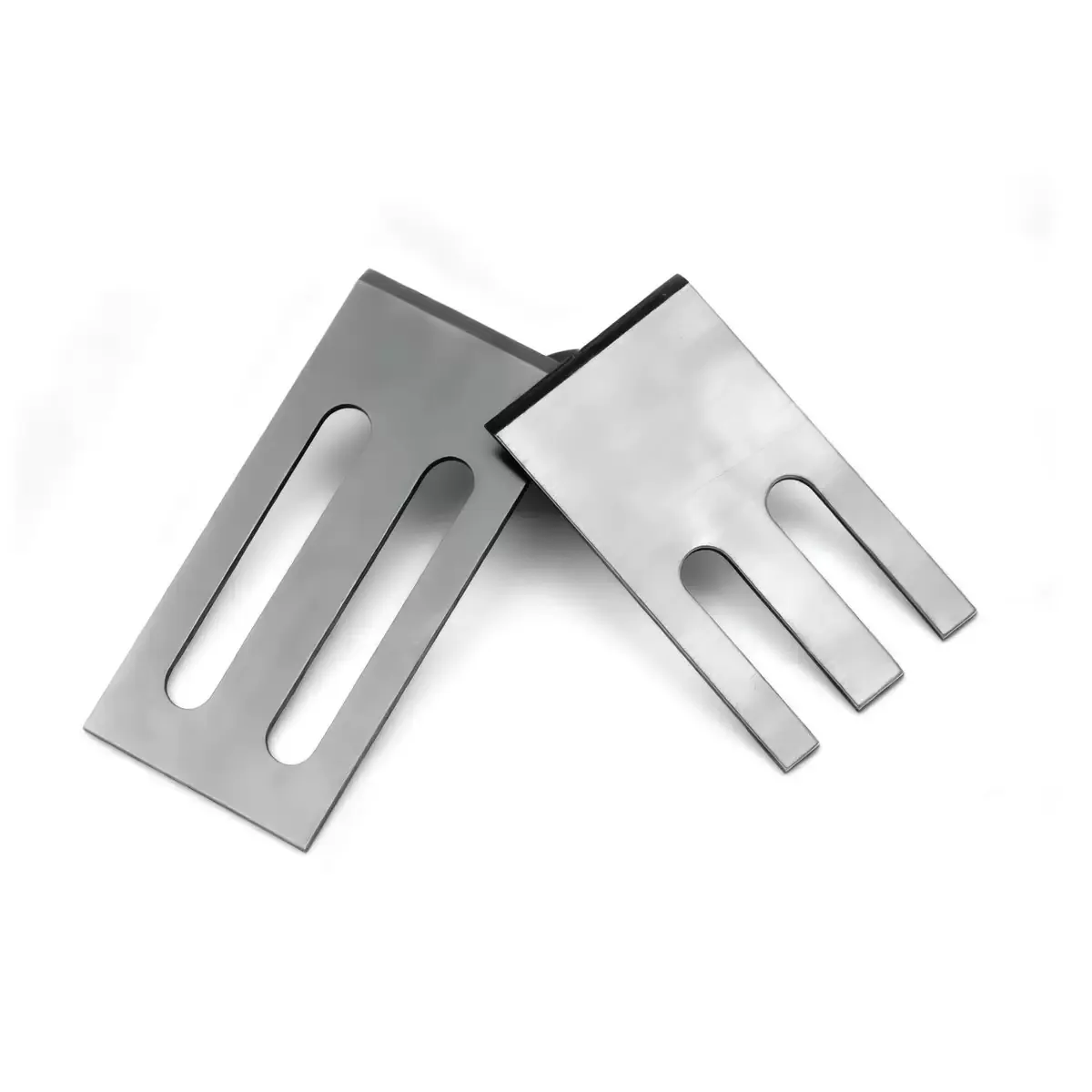
Die Face Cutting Knives & Pelletizer Blades
Die Face Cutting Knives
Cutting extruded strands in air rather than at the die face? See Strand Pelletizer Rotors for helical rotor and bed knife sets.
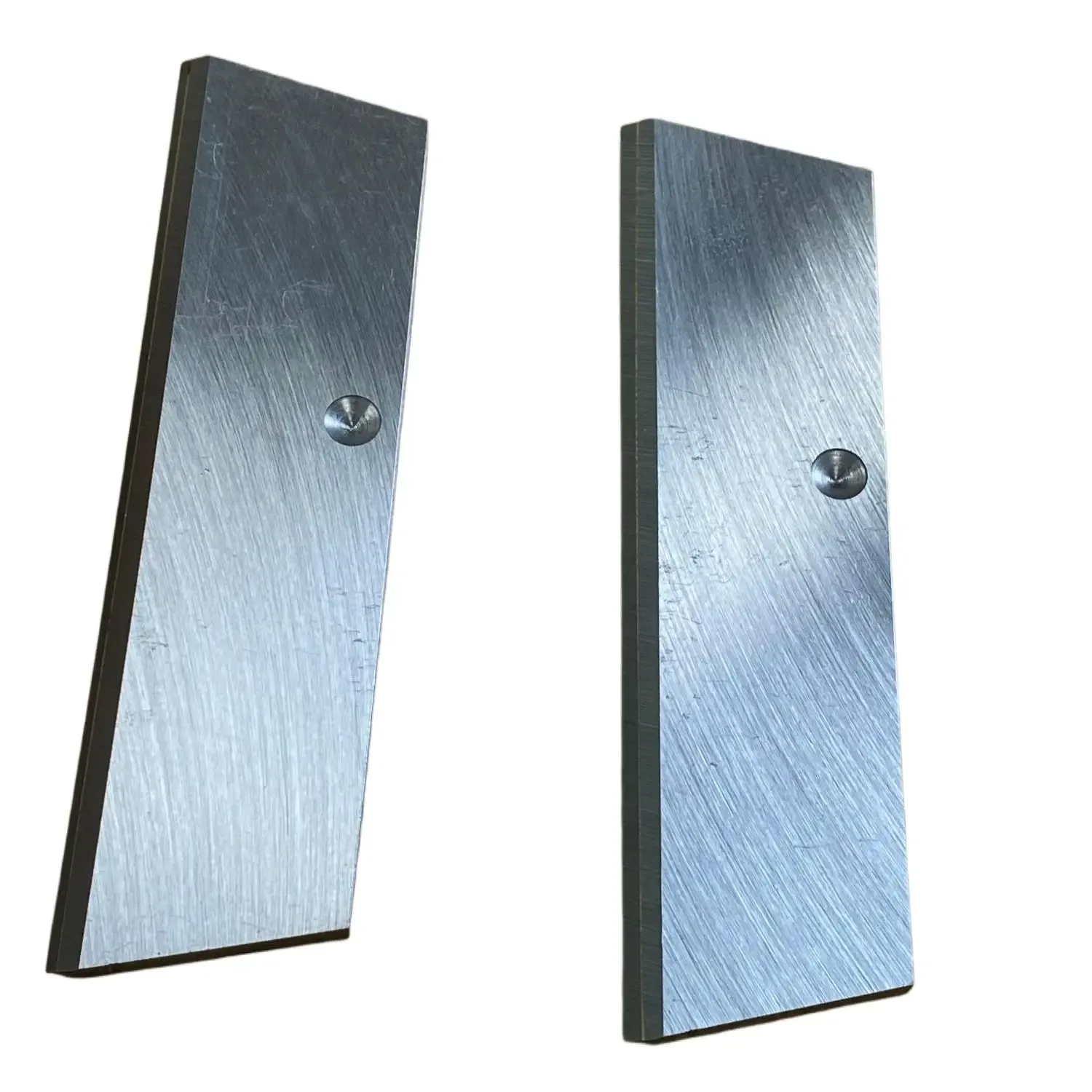
Die face cutting knives for underwater, water-ring and hot die face pelletizers, ground softer than your die plate. Fits Gala, Nordson BKG, Maag, ECON.
- ■Material: D2 · M2 HSS · T42 · PM-HSS · 440C Stainless · Carbide
■ ISO 9001:2015 Certified
■ In-House Heat Treatment
■ Strict Dimensional Tolerances
■ Global Door-to-Door Delivery
[ Engineering Reference ]
Decisive Specifications
| Material | D2 · M2 HSS · T42 · PM-HSS · 440C Stainless · Carbide |
|---|---|
| Hardness Differential | Blade held below die plate hardness (controlled wear) |
| Edge Geometry | 45° bevel · 90° square · Stepped bevel · Curved / hooked |
| Thickness Consistency | ≤ 0.01 mm variation within a matched set |
| Flatness | ≤ 0.01 mm |
| Pelletizing Methods | Underwater · Water-ring · Hot die face |
| Supply Format | Matched sets, CMM-verified; hubs and die plates available |
| OEM Fitment | Gala, Nordson BKG, Maag, ECON, Coperion, NGR |
■ All values verified via CMM inspection · ISO 9001:2015
[ RFQ Prompt ]
Need a Specific Size or OEM Replacement?
Don't see your exact specs? Send us a blueprint, a worn sample, or just your machine model. Our team will review the details and provide a tailored quotation.
[ Standard Reference ]
Common Standard Dimensions
| Blade Profile | Length × Width (mm) | Thickness (mm) | Mounting |
|---|---|---|---|
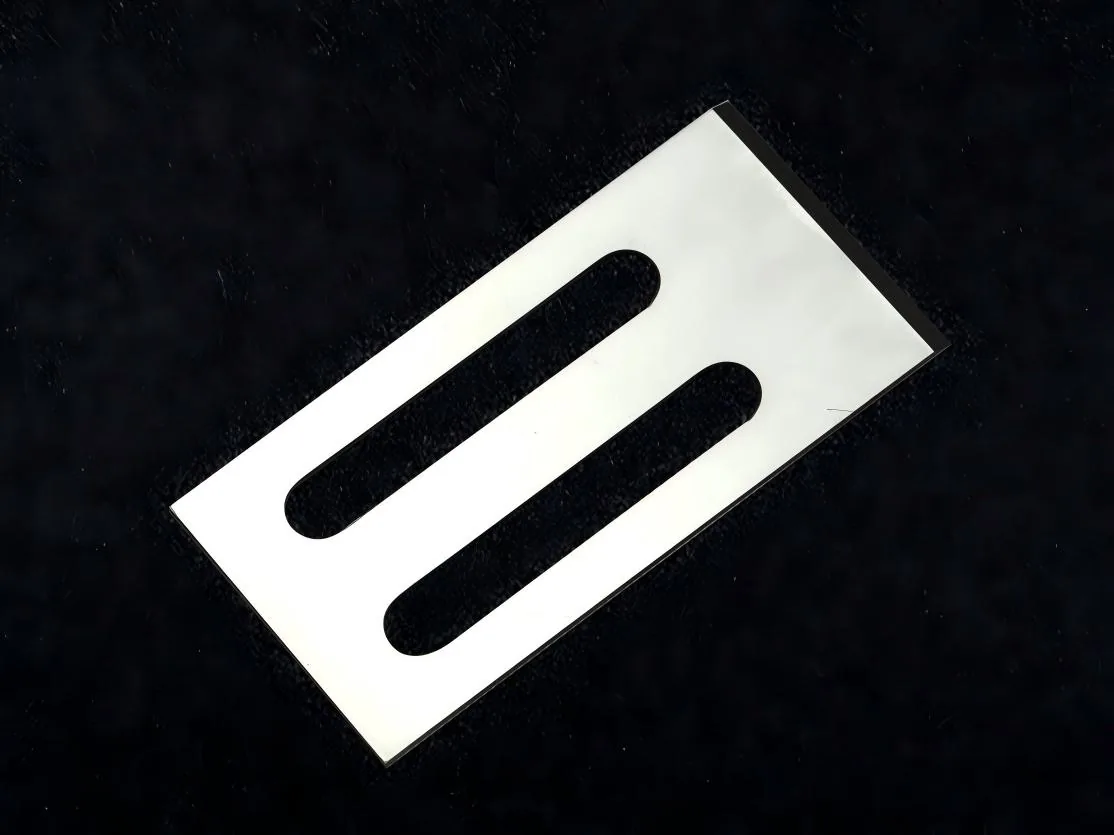
| Straight, twin slot | 45 × 25 | 3 – 6 | 2 × Ø5.5 slots |
| Straight, twin slot | 60 × 30 | 3 – 6 | 2 × R3.5 slots |
| Straight, wide body | 60 × 46 | 4 – 8 | 2 × R3.5, R5 relief |
| Forked, triple slot | 55 × 34 | 3 – 6 | 3 × R3.5 slots |
| Stepped / shouldered | 60 × 35 | 4 – 8 | 2 slots, 129° flank |
| Tapered / hooked | 70 × 60 | 4 – 8 | 63° flank |
[ OEM Compatibility ]
Compatible Machine Brands
® Registered trademarks are property of their respective owners. Sureay supplies compatible replacement blades — not OEM-branded parts.
[ Technical Audit ]
Engineering Advantages
The die plate is the asset; the blade is the consumable. Everything below follows from keeping that relationship the right way round.
Your Die Plate Outlives the Blade
Blade hardness is specified below the die face hardness so the consumable absorbs the wear. A blade harder than the die does not last longer — it scores the die face, opens the cutting gap and turns a blade change into a die refurbishment.
Ground and Verified as a Matched Set
Thickness consistency within ≤0.01 mm across the set, CMM-verified. A full set shares one preload against the die: thick blades take the load and score the die, thin ones never cut. Per-piece tolerance alone does not prevent this.
Edge Form Chosen From Your Polymer
45° for commodity polyolefins, 90° for filled and abrasive compounds, stepped bevel where a fine edge is needed but must survive, hooked for low-viscosity and tacky melts that smear against a straight edge.
[ Engineering Reference ]
Engineering Drawings & Blade Geometry
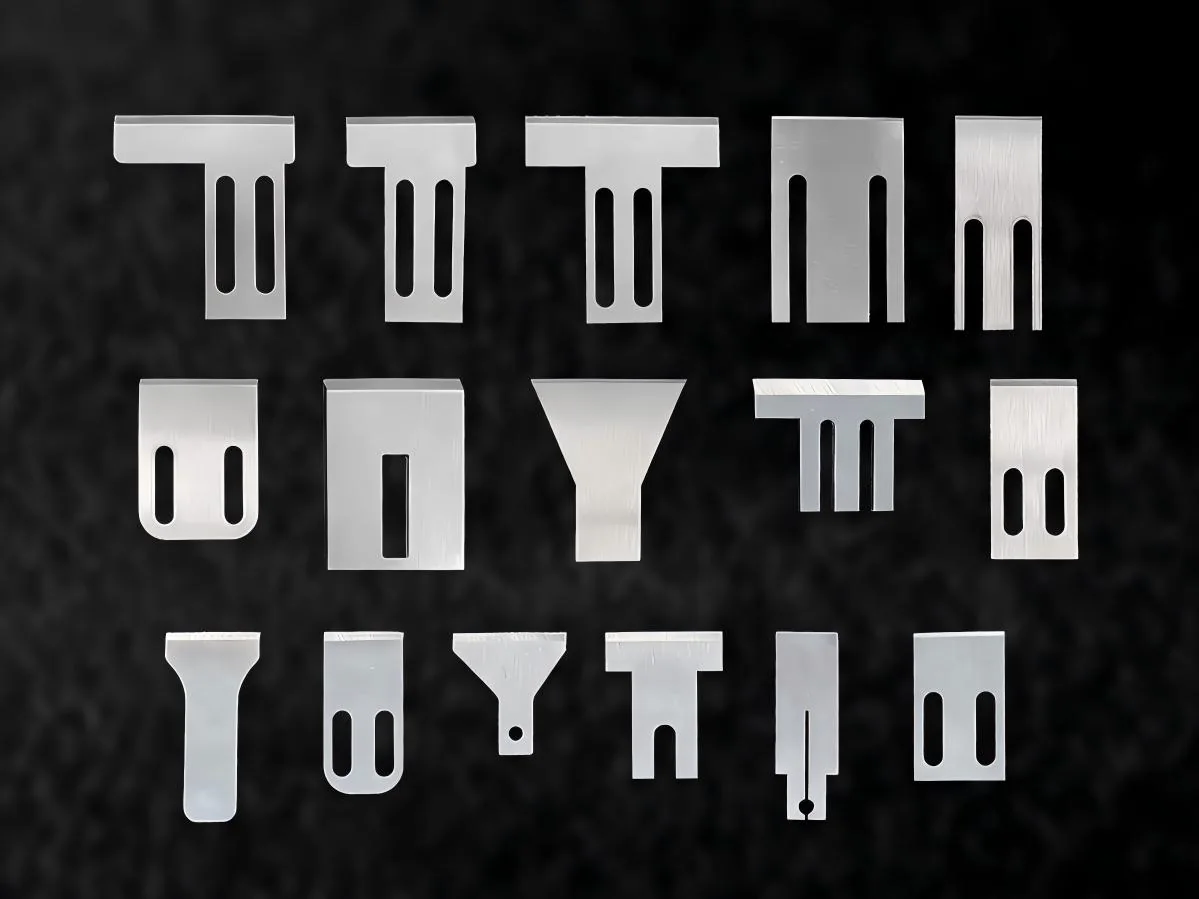
Most pelletizer blade orders reach us without an OEM drawing — a customer sends a worn blade, or a photograph and a machine model. The geometries below are drawings we produced that way, from measurement to approved manufacturing print. They show the range of body shapes, slot patterns and flank angles we hold in production, and what your own blade would look like once reverse-engineered.
■ Representative production geometries, dimensions in millimetres. Shown as a reverse-engineering capability reference, not a specification sheet — send your machine model or a sample blade for an exact drawing and quotation.
[ System Inventory ]
Related Blade Categories
View All →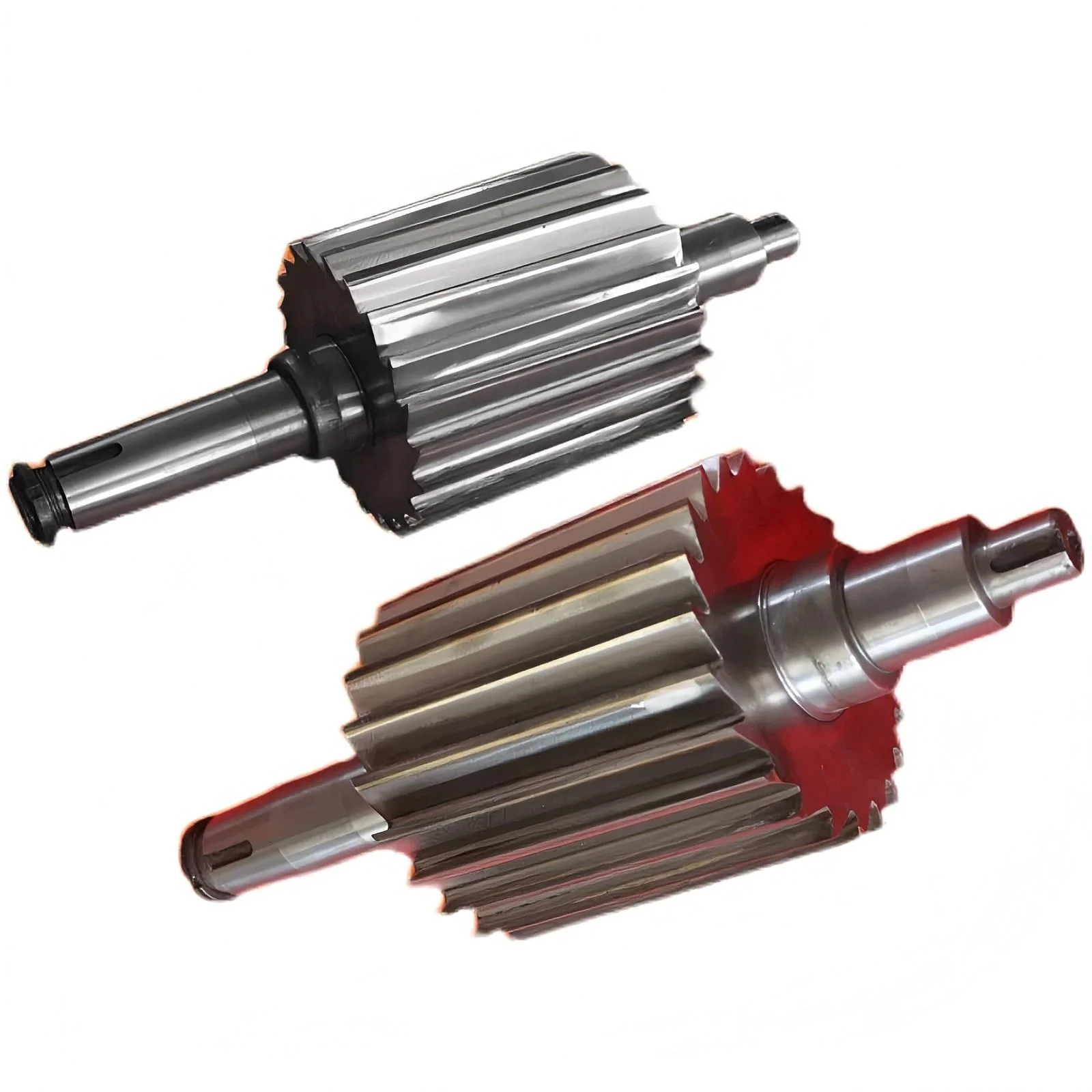

[ Knowledge Base ]
Product FAQs & Buying Guidance
Technical FAQs
01Will your blades damage my die plate?
+−
Will your blades damage my die plate?
Not if the hardness relationship is specified correctly, and that is the first thing we establish on any enquiry. The blade is deliberately held below the hardness of the die face so wear is absorbed by the consumable. A blade harder than the die plate does not give you longer life — it scores the die face, which opens the cutting gap, degrades pellet quality and eventually requires the die to be re-ground or replaced. Tell us the die plate material and hardness, or the machine model if you do not have it, and we specify the blade against it. Every shipment carries a hardness certificate so you can verify the relationship before the blades go on.
02Why does one blade in my set wear out much faster than the others?
+−
Why does one blade in my set wear out much faster than the others?
Almost always uneven thickness within the set. A full set of blades shares one preload against the die face, so if thickness varies from blade to blade the thickest ones carry a disproportionate share of the contact pressure — they wear rapidly and score the die, while the thinnest blades barely make contact and never cut properly. The set fails long before the average blade is worn out. This is why we grind blades in matched sets and CMM-verify thickness consistency across the set to within 0.01 mm, rather than inspecting each blade to a tolerance in isolation.
03Which edge geometry should I use — 45°, 90°, stepped or hooked?
+−
Which edge geometry should I use — 45°, 90°, stepped or hooked?
Choose from polymer viscosity and filler content. A 45° bevel is the general-purpose geometry and the right default for commodity polyolefins. Move to a 90° square edge for stiff, mineral-filled or highly abrasive compounds where a fine bevel would chip. A stepped bevel gives you a sharp cutting line with a robust land behind it, for cases where you need the fine edge but a plain 45° will not survive. Curved or hooked geometry draws the melt into the cut instead of pushing it away, which is what you want on low-viscosity or tacky polymers that smear against a straight edge.
04Should I use stainless steel blades for underwater pelletizing?
+−
Should I use stainless steel blades for underwater pelletizing?
440C stainless is worth specifying when corrosion is a real operating factor — particularly on lines that sit idle between campaigns, where a tool steel blade can develop surface rust in the water box that then scores the die on restart. The trade-off is edge retention: 440C will not hold an edge as long as M2 or PM-HSS at the same duty. If your line runs continuously and the water chemistry is controlled, tool steel or PM-HSS usually gives better cost per tonne. If it stops and starts, or the water box is not drained, the stainless option often pays for itself.
05How do underwater, water-ring and hot die face blades differ?
+−
How do underwater, water-ring and hot die face blades differ?
They differ mainly in the thermal and corrosive environment at the edge. Underwater blades run submerged and warm, so corrosion resistance is a genuine selection factor. Water-ring blades cut at a die face running in air with the water curtain downstream, which subjects the edge to more severe thermal cycling and favours tougher grades over the hardest ones. Hot die face blades cut dry against a heated die and see the highest edge temperature of the three, which is where PM-HSS and carbide earn their premium. Tell us which method your line uses — it changes the recommended grade even when the blade dimensions are identical.
06Do you supply cutter hubs and die plates as well as blades?
+−
Do you supply cutter hubs and die plates as well as blades?
Yes. Cutter hubs, die plates, threaded rods, blade fixing screws and O-rings are all available, and ordering the wear set together avoids the mismatch that causes uneven blade loading. If you are replacing a hub as well as blades, we recommend supplying them together so the blade seating faces and the hub are verified against each other before shipment.
Why Choose Sureay
01Can you reverse-engineer blades from a sample without an OEM drawing?
+−
Can you reverse-engineer blades from a sample without an OEM drawing?
Yes, and it is how most pelletizer blade orders begin. Send a sample blade — ideally an unworn one, or a worn one together with the machine model — and we produce a full dimensional drawing on our CMM for your approval before manufacture. We keep the approved drawing on file so repeat orders require no re-measurement. Your drawings and samples remain your intellectual property and are never shared.
02What is the lead time, and can I run a trial set first?
+−
What is the lead time, and can I run a trial set first?
Blades made to an existing approved drawing ship in 10–15 working days; first-time reverse-engineered sets add roughly 3–5 days for measurement, drawing and approval. We supply trial sets for fit verification and edge-life comparison against your current supplier before you commit to a production quantity.
03What documentation ships with a pelletizer blade set?
+−
What documentation ships with a pelletizer blade set?
Every set includes a Rockwell hardness certificate — the document that lets you verify the blade-to-die hardness relationship before installation — plus a CMM dimensional report covering thickness consistency across the set, a steel mill material traceability certificate and a heat treatment batch record.
Reach Our Team
Get in Touch with Our Engineers
Contact Our Team
Discuss your requirements directly with our engineers.
Request a Quote
Our engineering team responds within 2 hours.