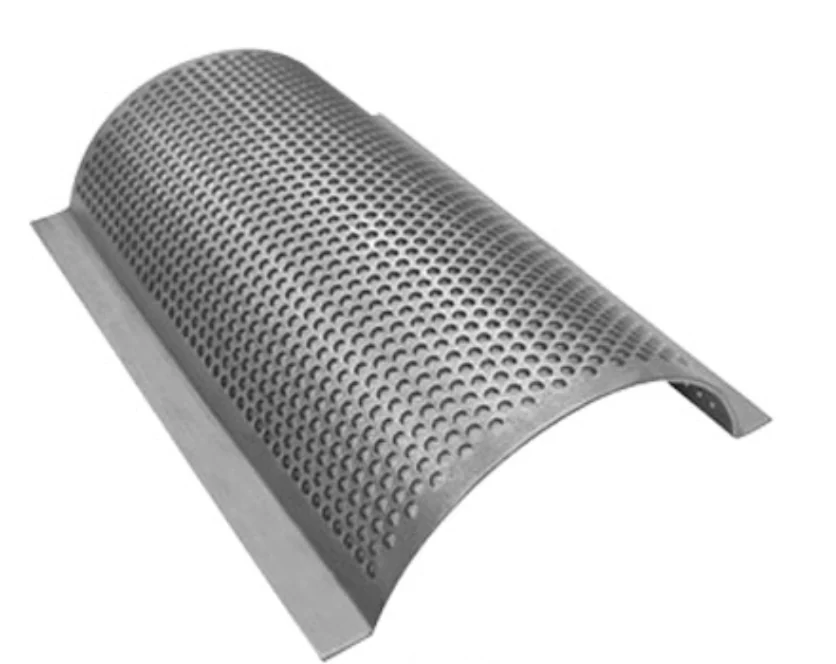
Shredder Screens, Baskets & Screen Plates
Shredder Screens
Looking for the cutting tools rather than the sizing screen? See Single Shaft Shredder Blades for rotor inserts, bed knives and holders.
Perforated shredder screens, baskets and screen plates in S355J2 and Hardox 400–500. Hole Ø 8–80 mm, 12–30 mm thick, reverse-engineered from your worn screen.
- ■Material: S355J2 · Hardox 400 / 450 / 500 · Hardfaced
■ ISO 9001:2015 Certified
■ In-House Heat Treatment
■ Strict Dimensional Tolerances
■ Global Door-to-Door Delivery
[ Engineering Reference ]
Decisive Specifications
| Screen Forms | Basket (half/full round) · Flat Plate · Sickle · Cassette |
|---|---|
| Hole Diameter | 8 – 80 mm (round, square or slotted) |
| Plate Thickness | 12 – 30 mm |
| Ligament Width | 5 – 20 mm (application-matched) |
| Material | S355J2 · Hardox 400 / 450 / 500 · Hardfaced |
| Open Area | 34 – 58% (pattern-dependent) |
| Hole Pattern | 60° staggered · Straight · Slotted |
| Supply Format | Drop-in OEM replacement or reverse-engineered from sample |
| OEM Fitment | Lindner, Vecoplan, UNTHA, WEIMA, Herbold, ZERMA |
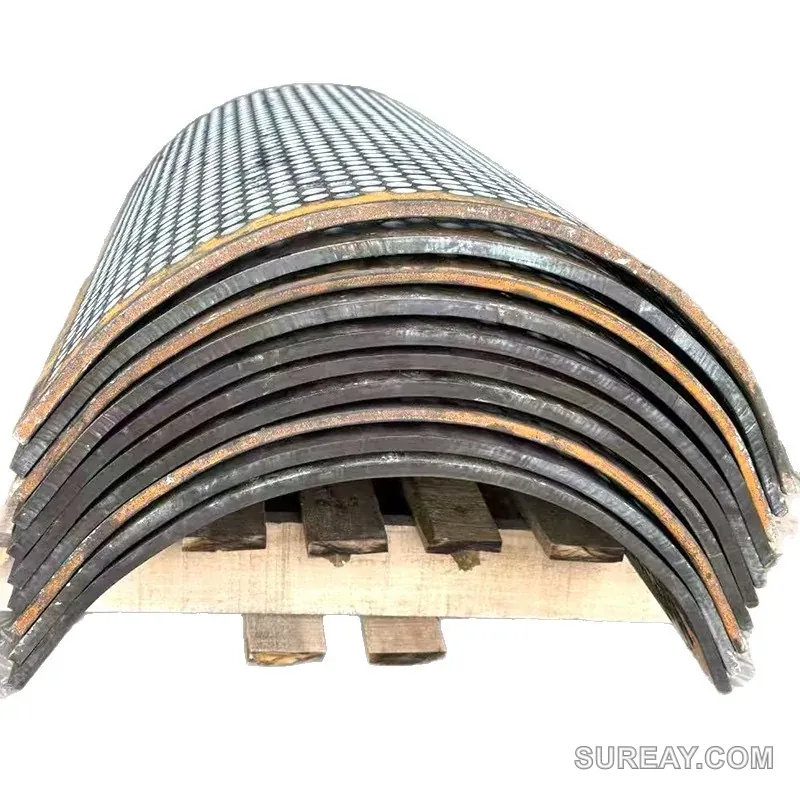
■ All values verified via CMM inspection · ISO 9001:2015
[ RFQ Prompt ]
Need a Specific Size or OEM Replacement?
Don't see your exact specs? Send us a blueprint, a worn sample, or just your machine model. Our team will review the details and provide a tailored quotation.
[ Standard Reference ]
Common Standard Dimensions
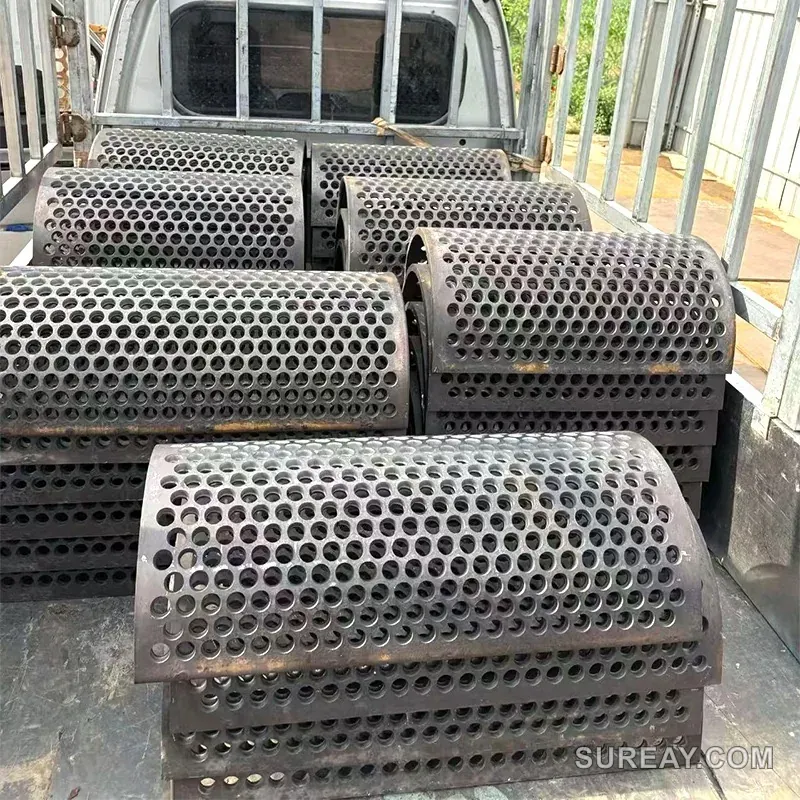
| Output Class | Hole Ø (mm) | Plate Thickness (mm) | Ligament (mm) |
|---|---|---|---|
| Fine regrind — PET flake, film | 8 | 12 – 15 | 5 |
| Fine regrind — PET flake, film | 10 | 12 – 15 | 5 |
| General regrind | 12 | 15 | 6 |
| General regrind | 16 | 15 – 20 | 7 |
| Coarse regrind | 20 | 20 | 8 |
| Coarse regrind | 25 | 20 – 25 | 9 |
| Pre-shred / bulky waste | 30 | 25 | 10 |
| Pre-shred / bulky waste | 40 | 25 – 30 | 12 |
| Primary shred / RDF | 50 – 80 | 30 | 14 – 20 |
[ OEM Compatibility ]
Compatible Machine Brands
® Registered trademarks are property of their respective owners. Sureay supplies compatible replacement blades — not OEM-branded parts.
[ Technical Audit ]
Engineering Advantages
A screen is judged on three things: whether it holds the particle size you specified, how long it holds it, and whether it survives the contamination in your feed without cracking.
The Screen Sets Your Output, Not the Rotor
Rolled to your exact rotor radius so the tip-to-screen gap stays uniform across the full width. A consistent gap means material is cut once and discharged, instead of being recirculated and ground into heat and fines.
Toughness, Not Blade Hardness
Screens are specified in S355J2, Hardox 400–500 or selectively hardfaced plate — never hardened to blade HRC. A brittle screen cracks at the ligaments and can drop steel into the rotor, taking a full knife set with it.
Screens, Counter Knives and Holders as One Order
A blinded or bell-mouthed screen accelerates knife wear, and worn knives blind the screen faster. We supply screens together with counter knives, knife holders, clamping bars and spacers so the whole wear set is replaced on the same shutdown.
[ System Inventory ]
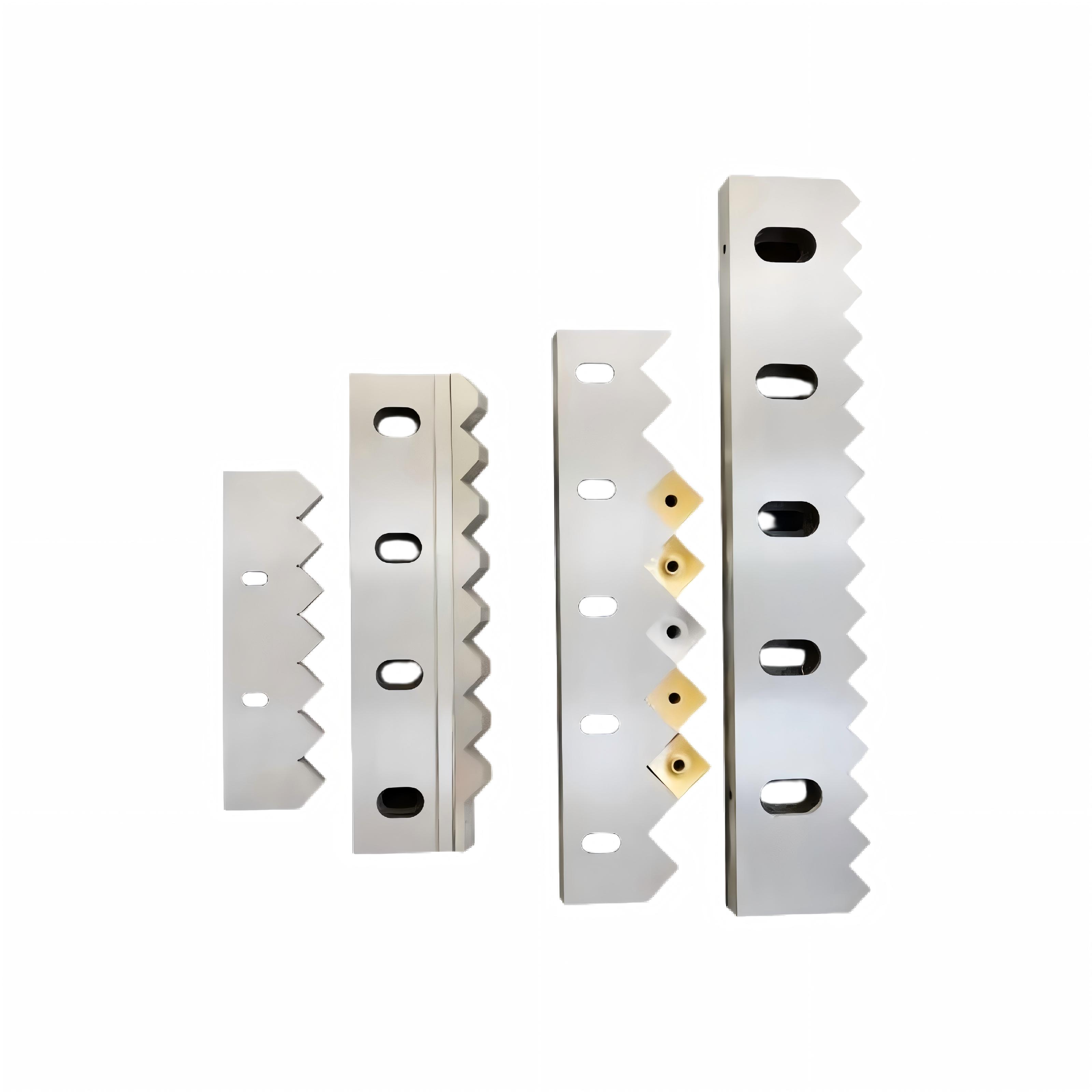
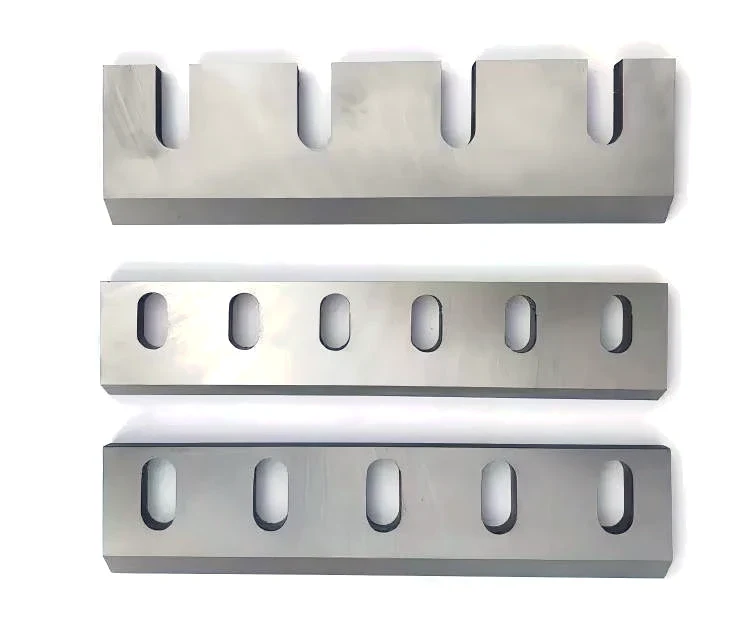
Related Blade Categories
View All →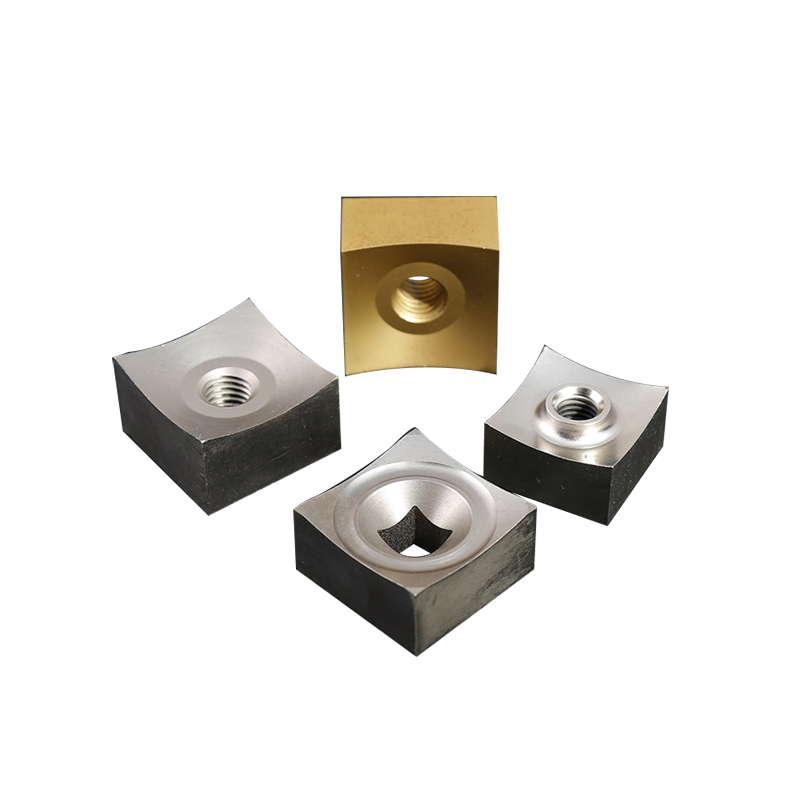
[ Knowledge Base ]
Product FAQs & Buying Guidance
Technical FAQs
01My throughput has dropped. Should I replace the screen or the knives first?
+−
My throughput has dropped. Should I replace the screen or the knives first?
Inspect the screen first, because it is cheaper to check and more often the cause. Look for bell-mouthing — holes that have worn conical and enlarged on the inner face — and for blinding, where softened plastic has plugged the apertures. If holes have grown more than about 10% over nominal, the screen is already passing oversize particles and should be replaced regardless of knife condition. In practice the two wear together: a dull knife pushes material against the screen instead of cutting it, and a blinded screen recirculates material that grinds the knife edge. Replacing only one usually means a second shutdown within weeks.
02What actually causes screen blinding, and how do I stop it?
+−
What actually causes screen blinding, and how do I stop it?
Blinding is almost always a heat problem, not a hole-size problem. When knives are dull or the rotor-to-screen gap has opened, material is smeared and worked rather than cut. Frictional heat softens the polymer, which then extrudes into the apertures and sets. Fitting a larger screen usually makes the coarse fraction unacceptable without fixing the cause. The durable fixes are sharpening or replacing the knives, restoring the correct rotor gap, and — for heat-sensitive polymers like LDPE and PP film — reducing feed rate or adding cooling. A thicker plate makes blinding worse, not better, because each hole becomes a longer channel to clear.
03How much open area can I add before the screen becomes structurally unsafe?
+−
How much open area can I add before the screen becomes structurally unsafe?
The limit is set by ligament width, not by open-area percentage. As a working rule, keep the ligament at or above 0.4× the hole diameter for clean plastics and at or above 0.6× for feed that may contain metal, stone or other hard contamination. A 20 mm hole with an 8 mm ligament gives roughly 46% open area and survives contaminated feed; the same hole with a 4 mm ligament reaches about 63% open area but will crack between holes under impact, typically starting at the discharge edge. On abrasive streams we would rather increase plate thickness and accept slightly lower open area than chase throughput with a thin ligament.
04Why shouldn't a screen be hardened to the same HRC as the blades?
+−
Why shouldn't a screen be hardened to the same HRC as the blades?
Because a screen fails differently from a blade. A blade needs edge retention and works in compression at the cutting edge; a screen is a perforated structural member absorbing continuous impact across a large span. Hardened to HRC 58–62, the ligaments lose the ductility they need to absorb shock and crack rather than deform. A cracked screen is far more expensive than a worn one, because fragments entering the rotor can destroy an entire knife set. We specify S355J2 for clean plastics, Hardox 400/450 for mixed post-consumer feed, and Hardox 500 or selective hardfacing for severely abrasive material — all chosen for toughness first.
05Can you manufacture a screen from my worn one if I have no drawing?
+−
Can you manufacture a screen from my worn one if I have no drawing?
Yes, and this is how most of our screen orders start. Send photographs of the worn screen with a tape measure laid across the hole pitch, plus the machine make and model and, where possible, the overall arc length and end-plate detail. We produce a manufacturing drawing for your written approval before any steel is cut. One important detail: we take hole geometry from the unworn edges rather than the enlarged centre holes, so the new screen restores your original particle size instead of reproducing the worn condition.
06Do you supply the counter knives, holders and clamping bars as well?
+−
Do you supply the counter knives, holders and clamping bars as well?
Yes. Screens, counter knives, knife holders, clamping bars and spacers are all manufactured in-house and routinely shipped together, which is how we recommend ordering them. Replacing the screen while leaving worn counter knives in place means the new screen blinds faster, and a single consolidated shipment reduces both freight cost and the number of production shutdowns.
Why Choose Sureay
01Are you a manufacturer or a trading company?
+−
Are you a manufacturer or a trading company?
We are a direct manufacturer established in 2008. Screens are cut, rolled, drilled and — where specified — hardfaced in our own workshop, which is why we can work from a photograph of a worn part rather than requiring a finished drawing.
02What is the lead time on a reverse-engineered screen, and how is it packed?
+−
What is the lead time on a reverse-engineered screen, and how is it packed?
Standard screens in stocked plate thicknesses ship in 10–15 working days from drawing approval. Reverse-engineered screens add roughly 3–5 days for the drawing and approval cycle. Screens are shipped on fumigated wooden pallets with edge protection and steel strapping; large-diameter baskets are nested to reduce volumetric freight cost.
03What documentation ships with a screen order?
+−
What documentation ships with a screen order?
Every order includes a dimensional inspection record against the approved drawing and a material certificate for the plate — including the Hardox mill certificate where Hardox grades are specified. Hardfaced screens additionally carry a record of the hardfacing consumable and deposited hardness.
Reach Our Team
Get in Touch with Our Engineers
Contact Our Team
Discuss your requirements directly with our engineers.
Request a Quote
Our engineering team responds within 2 hours.