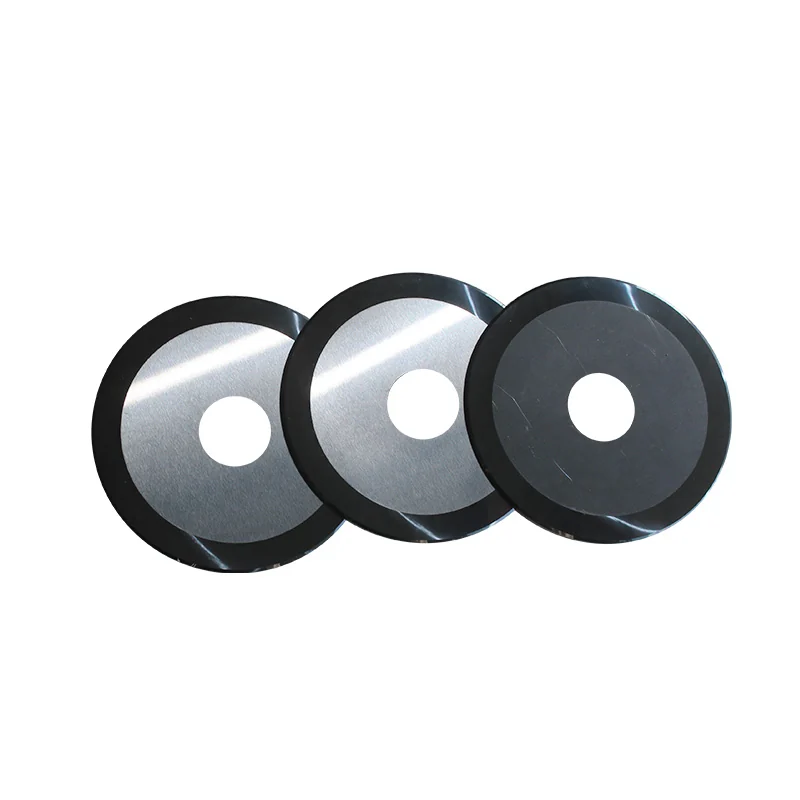
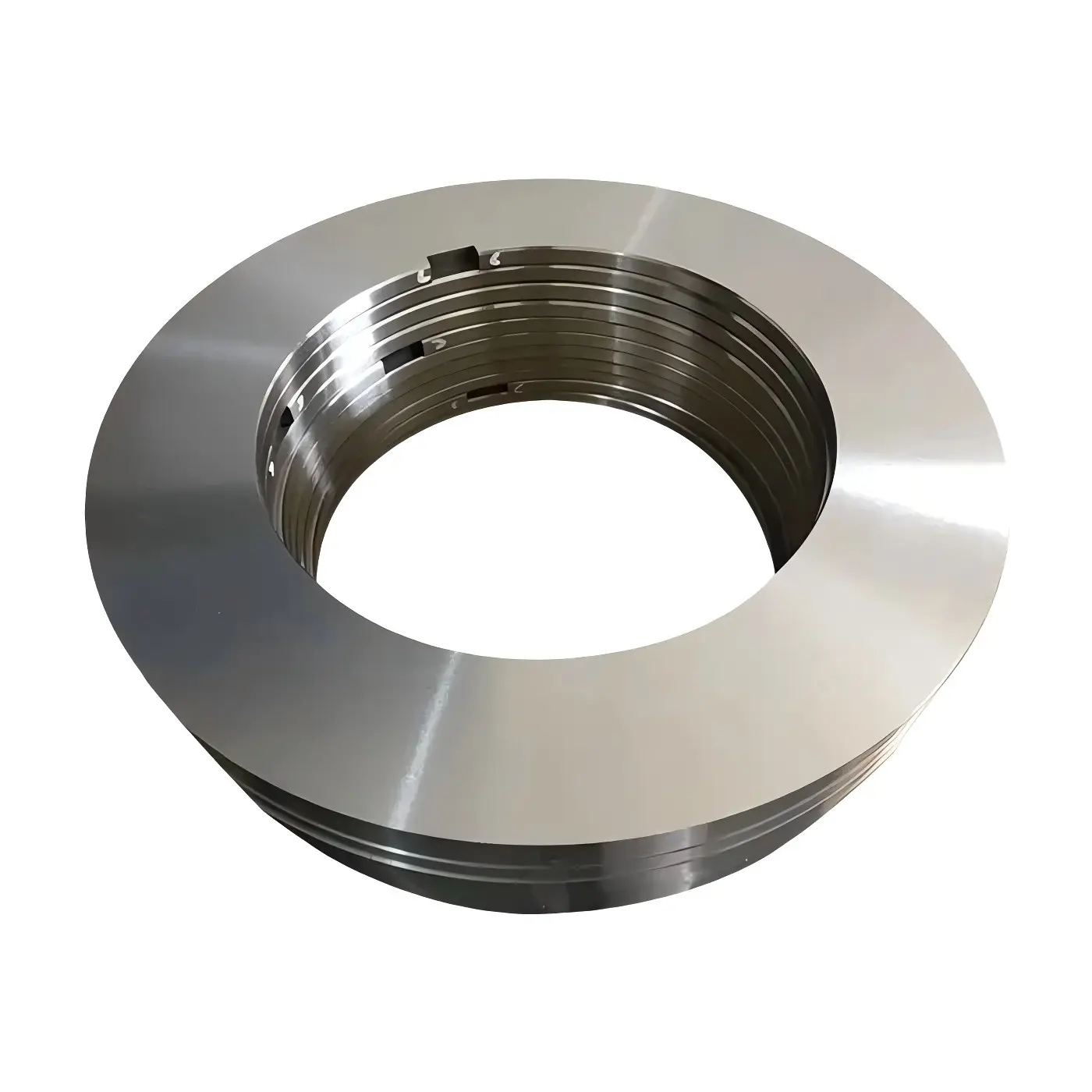
Tungsten Carbide Slitter Knives for High-Wear Slitting
Slitter Knives
Solid carbide costs six to ten times what D2 does. It earns that premium back in exactly two situations: when your web carries abrasive filler, or when your run lengths are long enough that changeover downtime — not blade price — is what actually costs you money. Micro-grain YG6, YG6X, YG8 and YG10X (ISO K10–K30) at 89.5–92.5 HRA, ground to ±0.002 mm, with a hardness and dimensional report in every shipment.
- ■Material: Micro-grain tungsten carbide — YG6 / YG6X / YG8 / YG10X (ISO K10 / K10UF / K20 / K30)
- ■Applications: Filler-loaded film, glass-reinforced laminate, abrasive nonwoven, coated foil & strip, high-speed coated board
■ ISO 9001:2015 Certified
■ In-House Heat Treatment
■ Strict Dimensional Tolerances
■ Global Door-to-Door Delivery
[ Engineering Reference ]
Decisive Specifications
| Material | Micro-grain tungsten carbide — YG6 / YG6X / YG8 / YG10X (ISO K10 / K10UF / K20 / K30) |
|---|---|
| Hardness | 89.5–92.5 HRA |
| Grain Size | 0.4–0.8 µm, ultra-fine to sub-micron |
| Transverse Rupture Strength | 2,500–3,000 N/mm² |
| Outer Diameter | 20–300 mm |
| Thickness | 0.3–5.0 mm |
| Tolerance | ±0.002 mm thickness | ≤0.005 mm parallelism | ≤0.01 mm T.I.R. runout |
| Edge Finish | Ra 0.2–0.4 µm |
| Edge Geometry | Single bevel, double bevel, hollow ground, razor |
| Coatings | Uncoated, DLC, TiN, TiAlN (optional) |
| Applications | Filler-loaded film, glass-reinforced laminate, abrasive nonwoven, coated foil & strip, high-speed coated board |
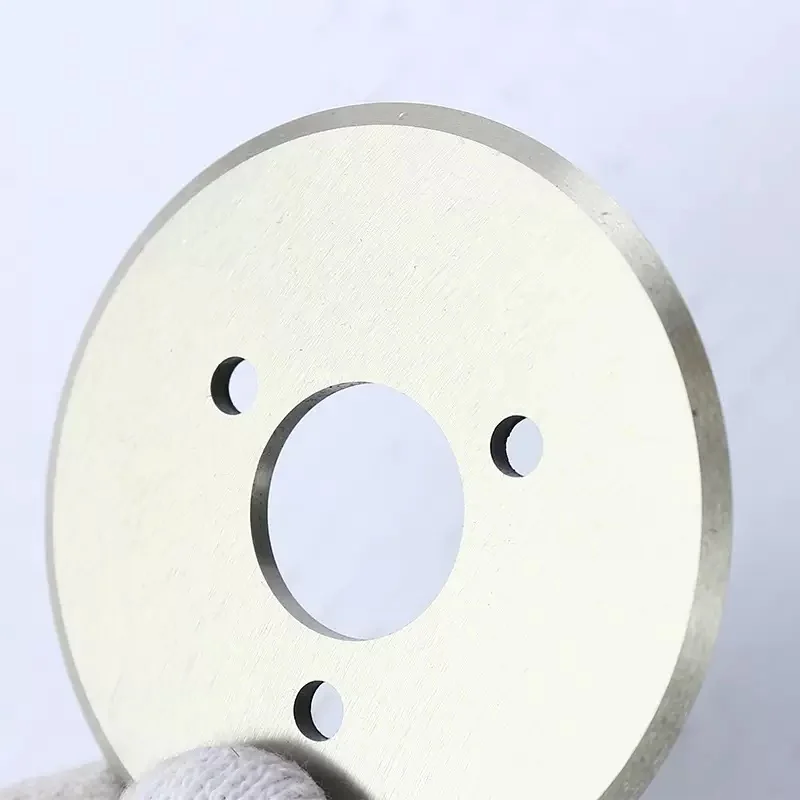
■ All values verified via CMM inspection · ISO 9001:2015
[ RFQ Prompt ]
Need a Specific Size or OEM Replacement?
Don't see your exact specs? Send us a blueprint, a worn sample, or just your machine model. Our team will review the details and provide a tailored quotation.
[ Material Selection ]
Which Steel Grade Should You Order?
Cobalt content is the trade-off dial: more cobalt means tougher and less brittle, but the edge dulls sooner. The four carbide grades below are shown against the tool steels they replace, so the upgrade decision is visible in one table. If your current steel blades are dulling, go harder. If they are chipping, go tougher. If both, the problem is usually clearance rather than material.
| Grade | Hardness | Best For | Trade-off |
|---|---|---|---|
| D2 | HRC 58–62 | General-purpose slitting of clean, unfilled substrates | Baseline edge life and baseline cost. Regrinds on conventional wheels. |
| M2 HSS | HRC 62–65 | Moderate wear at higher line speeds | 2–3× the edge life of D2 at roughly 1.5× the cost. |
| ASP23 PM | HRC 66–68 | High-speed, high-wear work short of true abrasives | 4–6× the edge life of D2 at roughly 3× the cost — frequently the better commercial choice. |
| YG6 (ISO K10) | 89.5–91.5 HRA | Steady, low-shock slitting of abrasive film and paper | 6% cobalt. The hardest of the four carbide grades and the least forgiving of shock. |
| YG6X (ISO K10UF) | 91–92.5 HRA | Thin gauge, tight tolerance, best achievable edge quality | 6% cobalt, ultra-fine grain. Sharpest edge, most sensitive to interrupted cuts. |
| YG8 (ISO K20) | 88.5–90.5 HRA | Nonwovens, foil, anywhere the web may snag | 8% cobalt. Tougher and shock tolerant, at the cost of some edge life. |
| YG10X (ISO K30) | 90.5–91.5 HRA | Interrupted cuts, laminates and heavier stock | 10% cobalt, ultra-fine grain. Best toughness-to-wear balance of the range. |
Across the range, carbide delivers roughly 10–30× the edge life of D2 at 6–10× the cost, takes fewer regrind cycles, and can only be reground on diamond wheels. How to run the arithmetic: carbide is worth it when the cost of stopping the line exceeds the cost of the blade. Tell us the material and the failure you are seeing now, and we will pick the grade.
[ OEM Compatibility ]
Compatible Machine Brands
® Registered trademarks are property of their respective owners. Sureay supplies compatible replacement blades — not OEM-branded parts.
[ Technical Audit ]
Engineering Advantages
Send a worn blade and your machine model — we will reverse-engineer the clearance and quote within 2 hours.
Where Carbide Earns Its Cost
Abrasive fill is what destroys steel edges, and hardness is the only defence. TiO₂-loaded BOPP, calcium-carbonate filled PE, FR-4 and prepreg trim, glass-fibre reinforced tape, mineral-loaded meltblown, coated aluminium and copper foil, and clay-coated board all wear a tool steel edge faster than the run length allows. The same grade logic applies whatever the substrate — this is a material decision, not an application one.
Where Carbide Is the Wrong Choice
Carbide is a wear-resistance solution, not a general upgrade. It chips where D2 would deform — on splices, snags and interrupted cuts, or where the knife can touch the anvil metal-to-metal. On clean unfilled substrates and short runs, D2 or ASP23 PM holds an edge long enough at a fraction of the price. And without diamond-wheel regrinding access, a dulled carbide blade is scrap rather than an asset. If any of that describes your line, say so when you enquire — we would rather quote the right steel.
Micro-Grain Substrate, Chosen Per Job
We select from four grades against your material and your current failure mode rather than shipping one grade for everything. Sub-micron grades hold a keener edge; higher-cobalt grades survive shock. Carbide can only be finished on diamond wheels, and edge geometry, parallelism and runout are held to the same inspection standard as our tool steel grinding — every blade measured before dispatch, with a hardness test report and dimensional record in the box.
[ System Inventory ]
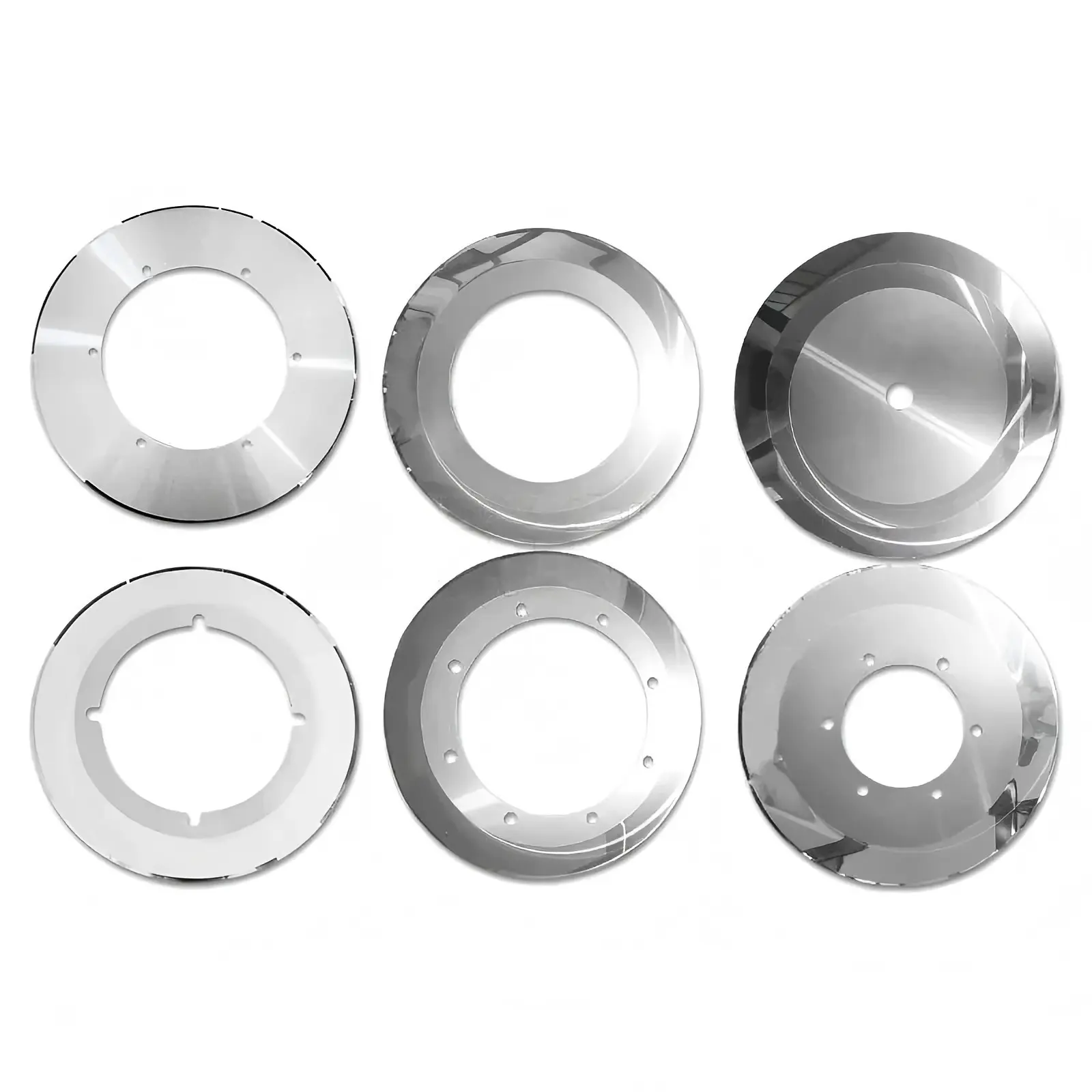
Related Blade Categories
View All →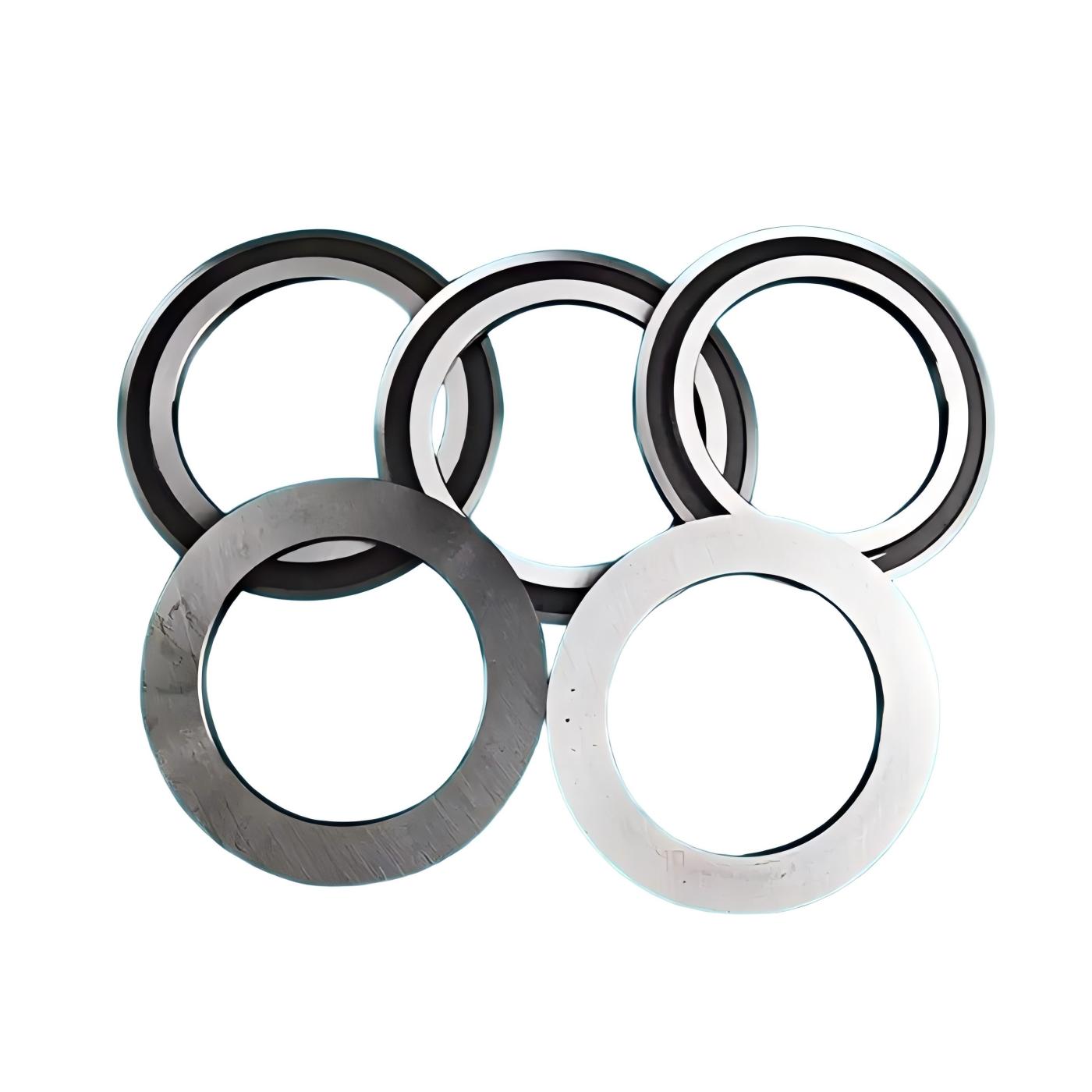
[ Knowledge Base ]
Product FAQs & Buying Guidance
Technical FAQs
01When should I choose solid carbide over M2 HSS or D2?
+−
When should I choose solid carbide over M2 HSS or D2?
Only when your web carries abrasive filler, or when your run lengths are long enough that regrind and changeover savings cover the 6–10× price difference. For standard clear film, plain paper or unfilled PE, D2 or ASP23 PM is usually the better commercial choice — and we will say so.
02How many times can a carbide slitter knife be reground?
+−
How many times can a carbide slitter knife be reground?
It depends on the thickness allowance designed into the blade, not on the material. Each regrind removes stock; the practical limit is where the blade thins past its clearance tolerance. Carbide typically takes fewer regrinds than D2 but delivers far more running time between each one, which is where the economics actually sit. Diamond wheels are required — conventional aluminium-oxide wheels will glaze and will not cut carbide.
03My carbide blade chipped on the first run — what went wrong?
+−
My carbide blade chipped on the first run — what went wrong?
Almost always one of three things. Handling: a carbide blade dropped on a concrete floor develops internal stress and cracks that stay invisible until load is applied. Clearance: set too tight, the knife makes metal-to-metal contact with the anvil and micro-chips along the edge. Or the application has shock in it — a splice, a snag, an interrupted cut — that carbide's brittleness cannot absorb. Send us a photo of the chipped edge; the fracture pattern usually identifies which of the three it was.
04YG6 or YG8 — which grade should I specify?
+−
YG6 or YG8 — which grade should I specify?
YG6 (ISO K10) is harder and lasts longer on steady, clean, abrasive work. YG8 (ISO K20) carries more cobalt, so it is tougher and tolerates shock at the cost of some edge life. If your current steel blades are dulling, go harder. If they are chipping, go tougher. If both, the problem is usually clearance rather than material.
05Can a carbide top knife run against a steel bottom anvil?
+−
Can a carbide top knife run against a steel bottom anvil?
Yes, and it is common — but the anvil then becomes the wear part and will need attention sooner than before. If the anvil is softer, verify clearance more often, since anvil wear opens the gap and the first symptom is a ragged edge that looks like a knife problem. Matched carbide pairs are available where anvil wear is the limiting factor.
06How should carbide blades be stored and handled?
+−
How should carbide blades be stored and handled?
Individually separated, never stacked bare metal-to-metal, in a dry environment. Most carbide failures we investigate started in the stockroom or in transit, not on the machine. Blades ship in protective packaging that is worth keeping for the ones you are not running.
Why Choose Sureay
01Are you a manufacturer or a trading company?
+−
Are you a manufacturer or a trading company?
We manufacture. Grinding, heat treatment control and inspection are done in our own ISO 9001:2015 certified facility, in operation since 2008 and shipping to 50+ countries. That is why we can quote against a worn sample and stand behind the dimensional record that ships with it.
02Can you make carbide blades without an OEM drawing?
+−
Can you make carbide blades without an OEM drawing?
Yes — send a worn blade and your machine model. We measure the sample, reverse-engineer the working clearance from the wear pattern, and produce a matched replacement; the wear pattern usually tells us more about how the knife is actually running than the original drawing does. Bore, keyway, mounting-hole pattern and thickness are matched to the arbors you already run, so there is no holder change and no retooling.
03What documentation ships with a carbide order?
+−
What documentation ships with a carbide order?
A hardness test report and a dimensional inspection record with every shipment, from an ISO 9001:2015 certified facility. If your incoming inspection needs full CMM data, ask when you order and it ships with the blades. Where several knives share a shaft, they are ground and shipped as a verified matched set so stack-up error does not accumulate across positions.
04Can we trial a small carbide set before committing to a full order?
+−
Can we trial a small carbide set before committing to a full order?
Yes. We supply trial sets — typically 2–5 blades — for machine fit verification and edge life testing against your current steel blades. We would rather you prove the payback on your own line than take our word for the multiplier. For custom profiles, a dimensional sign-off sample is produced before full production starts.
05What is the lead time on carbide slitter knives?
+−
What is the lead time on carbide slitter knives?
Standard profiles in stocked grades ship in 7–12 working days; custom geometry and non-standard diameters take 15–20. Carbide runs longer than tool steel because sintered blanks and diamond-wheel finishing cannot be rushed without costing you edge quality. Blades ship individually separated in protective packaging — most carbide damage we investigate happened in transit or storage, not on the machine.
Reach Our Team
Get in Touch with Our Engineers
Contact Our Team
Discuss your requirements directly with our engineers.
Request a Quote
Our engineering team responds within 2 hours.